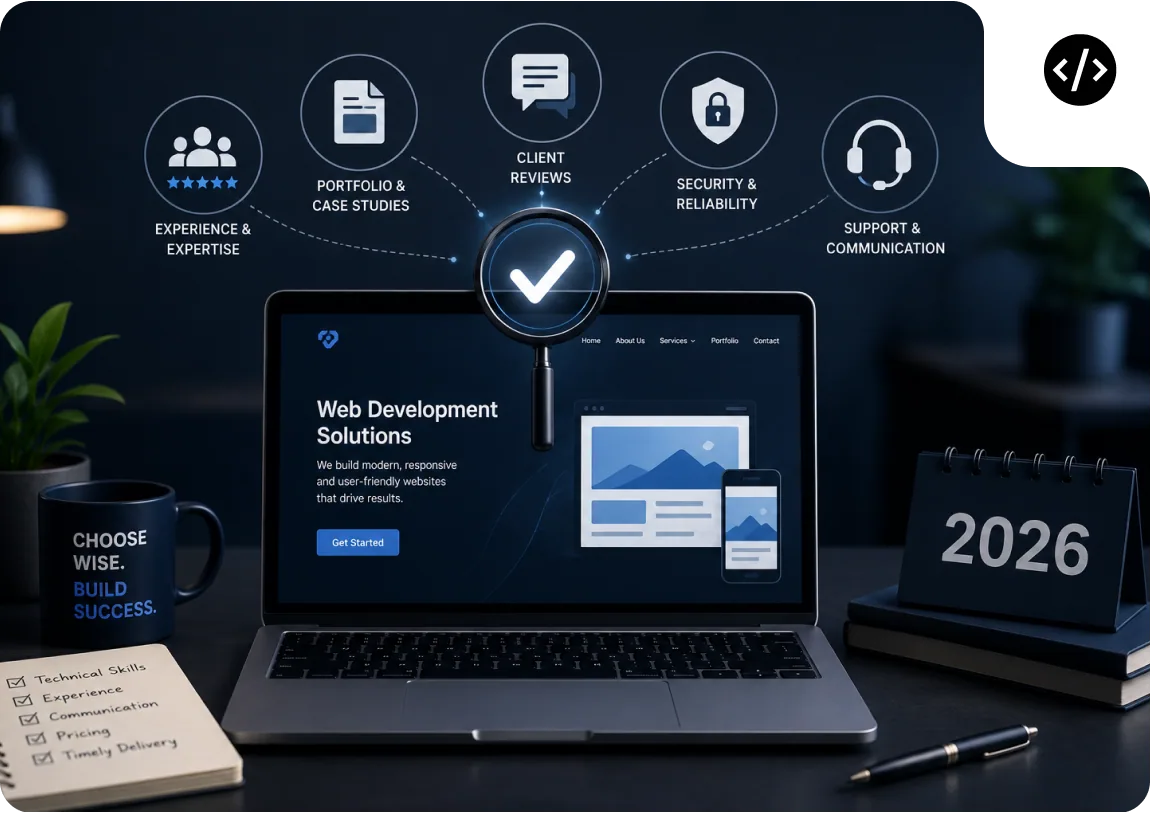
The problem with hiring a web development company is that you cannot know their track record until after you have experienced it. They know exactly what they have delivered before. You are working from their marketing copy and portfolio screenshots. This guide closes that gap, with criteria that are independently verifiable before you sign anything.
TL;DR:
- 5 signals that predict quality: Reviews (third-party), named long-term clients, published rate, discovery call questions, pre-project communication.
- 10 questions to ask: rate, scope, ownership, subcontractors, revisions, support, all before signing.
- 7 red flags: no third-party reviews, generic proposal, no published rate, 100% upfront, subcontractors, no long-term clients, contact changes.
- Contract non-negotiables: IP assignment, written scope, milestone payments, repo ownership.
The Asymmetric Information Problem
What the agency knows that you don't
Every web development company knows its own track record. How many projects were delivered on time. How many required significant rework. How many clients came back for a second project.
You are evaluating them from their best side: a curated portfolio, selected testimonials, and a polished website.
The tools that close the gap
- Third-party review platforms (Clutch, Freelancer.com, Google) collect client reviews independently. The agency cannot edit or remove unfavourable reviews.
- Named long-term clients are verifiable, you can contact them directly.
- Published rates eliminate post-discovery anchor pricing.
- Discovery call quality reveals how the agency thinks before money is on the table.
- Pre-project communication patterns predict project communication patterns.
These five tools exist. Most buyers use only one or two of them.
The 5 Signals That Predict Whether a Company Delivers
Signal 1, Third-Party Review Volume and Recency
Reviews on your own website are marketing. Reviews on Clutch.co and Freelancer.com are submitted directly by clients after project completion. The agency cannot edit or remove them.
What to look for: 50+ reviews on at least one third-party platform. Reviews from the past 12 months (not all from 5 years ago). Specific review content, not just star ratings.
Read 10 reviews. If most are generic ('great team, highly recommend'), they are less useful than specific reviews that describe a project outcome.
Signal 2, Named Long-Term Clients
Any company can do one project well. A company with clients who have returned every year for 5 or more years has demonstrated sustained quality.
Ask directly: 'Can you name a client you have worked with for more than 3 years?' A strong company names someone. A weak one says 'all our clients are confidential.'
Confidentiality covers content, not the existence of the relationship. 'We work with a company in the Netherlands' is fine. Naming them is better.
Signal 3, Published Hourly Rate
An agency that publishes its rate before any conversation is signalling confidence in its value. It is not trying to learn your budget before anchoring a number.
An agency that only reveals rates after a 'needs assessment' call is optimising for negotiation leverage.
Both models exist in the market. The published-rate model is more transparent.
Signal 4, Discovery Call Quality
Before sending a proposal, a good agency asks specific questions: What is the problem you are solving? What does success look like? What have you tried before? What is the timeline and why? Who are the decision-makers?
A proposal that arrives before these questions have been asked was not written for your project. The same agency will ask the same poor questions when a problem arises mid-project.
Signal 5, Communication During Evaluation
The speed, clarity, and specificity of their responses to your initial enquiry is a direct proxy for how they will communicate when you are a paying client.
A slow, generic response to a detailed project enquiry is not an anomaly. It is a preview.
10 Questions to Ask Any Web Development Company Before Signing
Question 1: Can you name a client you have worked with for more than 3 years?
Why it matters: sustained quality requires consistent delivery over time, not one good project.
Strong answer: a name, ideally with a project description.
Weak answer: 'We have an NDA' or 'We prefer not to share client details.'
Question 2: What is your hourly rate?
Why it matters: fixed-price quotes can hide rate and hours. Knowing the hourly rate lets you validate whether a fixed quote reflects a reasonable estimate.
Strong answer: a number. Immediately.
Weak answer: 'It depends on the project. Let's schedule a call.'
Question 3: Will you produce a written scope document before I pay anything?
Why it matters: a vague brief produces a vague quote and a disputed delivery. Written scope lists every deliverable and every exclusion.
Strong answer: 'Yes. The scope is produced after the discovery call and before any payment.'
Weak answer: 'We work flexibly' or 'We'll figure it out as we go.'
Question 4: Who specifically will work on my project, your employees or subcontractors?
Why it matters: subcontractors introduce a layer you cannot see or vet.
Strong answer: 'All our developers are direct employees.'
Weak answer: 'We have a network of trusted partners.'
Question 5: What happens if the project runs over the agreed budget?
Why it matters: scope changes are the most common source of project disputes.
Strong answer: 'Any scope change requires written approval and a revised quote. We do not add hours without your sign-off.'
Weak answer: 'We'll always find a way to make it work.'
Question 6: Who owns the code when the project is complete?
Why it matters: the answer should be 'you do.'
Strong answer: 'All work product transfers to you on final payment. It's in our standard agreement.'
Weak answer: hesitation, or 'we retain the right to use it in our portfolio.'
Question 7: How many revision rounds are included, and what do additional rounds cost?
Why it matters: 'unlimited revisions' is a red flag, not a benefit. It means scope is undefined and the project has no natural end.
Strong answer: '2 rounds of design revisions included. Additional rounds are billed at $X per hour.'
Question 8: What does post-launch support include?
Why it matters: bugs appear after launch. The support scope affects your risk.
Strong answer: '30 days of bug-fix support at no charge. Ongoing maintenance is available as a retainer.'
Question 9: What project management tools do you use and will I have access?
Why it matters: real-time visibility into task status reduces surprises.
Strong answer: 'We use ClickUp / Jira. You will have access throughout the project.'
Weak answer: 'We'll send you weekly updates by email.'
Question 10: What is your payment structure?
Why it matters: payment structure determines incentive alignment.
Strong answer: '30% to start, 40% at midpoint, 30% on delivery.'
Weak answer: '100% upfront' or '50% upfront, 50% at launch.'
7 Red Flags in a Web Development Company
Red flag 1, No third-party reviews
If a company has only testimonials on its own website, they chose which reviews to show. A company with 200 projects and no Clutch profile chose not to publish independently. Ask: 'Can you share your Clutch or Freelancer profile?' before the call.
Red flag 2, Generic proposal before a discovery call
A proposal sent before any questions were asked was not written for your project. It was written for a template of your project. The same agency will make the same mistakes when your project does not fit their template.
Red flag 3, Rate not published
'We need to understand your project before we can give you a rate' means 'we need to understand your budget before we anchor a number.' Hourly rate is not project-specific. A transparent agency publishes it.
Red flag 4, 100% upfront payment required
Standard payment: 30% to start, 40% at midpoint, 30% on delivery. 100% upfront removes the agency's accountability for the second half. If an agency insists on this structure, ask why. A strong answer: 'We've been burned before.' Acceptable for small projects. For anything over $10,000: walk away if they cannot move to milestone payments.
Red flag 5, Subcontractor model
If you cannot be introduced to the specific developers working on your project, they may not be employees of the company you hired. Ask: 'Are all developers on this project direct employees of your company?' A 'yes' you can verify (LinkedIn, team page) is different from an unverifiable 'yes.'
Red flag 6, Cannot name a long-term client
'All our clients are confidential' is sometimes legitimate for specific industries. For a general web development company, it typically means their clients did not return. Ask for the name of one client who has worked with them for more than 3 years. If they cannot name one, factor this into your evaluation.
Red flag 7, Primary contact changes between conversations
A different account manager at every call means there is no single accountable person. Ask: 'Who will be my single point of contact throughout this project?' And: 'Will that person be involved in the technical delivery, or only account management?'
What a Portfolio Actually Tells You
What screenshots prove
Design skill. Whether the agency can produce a professional-looking interface.
Nothing about: whether the project was delivered on time, on budget, whether the client was satisfied, whether the site still works two years later, or whether the agency built it or just styled a template.
Questions that reveal more than the screenshots
- 'Is this client still with you?', a client who returned for more work is evidence.
- 'How long did this project take and what was the budget?', compare against their estimate.
- 'What was the biggest challenge on this project?', a good agency describes a real problem.
- 'Can I contact this client directly?', a confident agency says yes.
The highest-value portfolio element:
A named client who has been with the agency for 3 or more years. That relationship survived the initial enthusiasm and the messy middle. It tells you more than any screenshot.
Non-Negotiable Contract Terms
IP assignment
All work product, code, design files, documentation, transfers to you on final payment. This should be explicit, not implied.
Written scope document
Every deliverable listed. Every exclusion named. Ambiguity in the scope document becomes a dispute during delivery.
Milestone-based payment
30% to start. 40% at a defined midpoint deliverable. 30% on final delivery. Never 100% upfront for projects over $5,000.
Repository ownership
Code stored in your GitHub or GitLab organisation, not the agency's. If you part ways mid-project, the code stays with you.
Revision policy
Specific number of revision rounds included (2 is standard). Cost of additional revision rounds stated clearly. 'Unlimited revisions' is undefined scope, it should be 'unlimited revisions within the agreed scope.'
Post-launch support period
30-day bug-fix support at no charge is standard for most agencies. What constitutes a bug vs a new feature should be defined.
Working on a web development project?
Written scope before billing. $30/hr. We tell you if we're not the right fit.
How CV Infotech Measures Against These Criteria
We recommended these criteria. Here is our own score.
Third-party reviews
512 verified 5.0 reviews on Freelancer.com. 5 verified 5.0 reviews on Clutch. Both are publicly accessible. We did not select which reviews appear.
Named long-term clients
- Francisco Escobar, client since 2012. Based in the Netherlands. GiftCards platform.
- Steven, client since 2019. UltimaBot and UltimaWriter, AI SaaS platforms.
- Laura Maher, 'Communication is 10 out of 10. Barely notice the time difference.'
- John Gowland, 8-month build, UK real estate platform. 'Exceeded my expectations.'
Published rate
$30/hour. Published on every service page. Not revealed after a needs assessment call.
Discovery call quality
We assess whether your project needs custom software or an existing platform. We ask about timeline, budget, requirements, and stakeholders before quoting. If a SaaS tool or CMS handles your requirement, we say so.
Pre-project communication
We respond within 24 hours. We read the brief before the call. We do not send a generic proposal before questions are asked.
What we do not claim
We are not the right fit for every project. One-time tasks, very small budgets, and projects that need daily in-person collaboration are better served by others. We say this on every service page's NOT FOR YOU section.
If after reading this guide you decide we are worth a call: Book a 30-minute discovery call.
Frequently Asked Questions
The five signals that best predict a reliable web development company are: (1) Third-party review volume on Clutch or Freelancer.com, 50+ reviews over multiple years, not selected testimonials. (2) Named long-term clients, a company that can name a client they have worked with for 5+ years has demonstrated sustained quality. (3) Published hourly rate, transparent pricing before the first call. (4) Discovery call quality, the questions they ask before quoting tell you how they will work during the project. (5) Communication during evaluation, how they respond to your enquiry before the project starts predicts how they communicate during it.
Ten essential questions: (1) Can you name a client you have worked with for more than 3 years? (2) What is your hourly rate? (3) Will you produce a written scope before I pay anything? (4) Who specifically will work on my project, employees or subcontractors? (5) What happens if the project runs over the agreed budget? (6) Who owns the code when the project is complete? (7) How many revision rounds are included? (8) How do you handle changes to the scope mid-project? (9) What project management tools do you use and will I have access? (10) What does post-launch support include?
Seven red flags that predict a problematic engagement: (1) No reviews on third-party platforms, only curated testimonials on their own website. (2) Proposal sent before a discovery call. (3) Rate not published before the call. (4) 100% upfront payment required. (5) Cannot name the specific developers who will work on your project. (6) Cannot name a long-term client relationship. (7) Primary contact changes between conversations.
A portfolio of screenshots proves design skill but not delivery reliability. To evaluate a portfolio properly: ask for the names of the clients in the portfolio and verify they exist. Ask which projects are still maintained by the same agency, an agency that builds and hands over is different from one that builds and maintains. Ask for the outcome, not just the deliverable: 'Did this site hit the performance targets? Is the client still with you?' The most valuable portfolio element is a named client who has been with the agency for 3+ years, that relationship survived the initial enthusiasm and the messy middle of a real working relationship.
The choice between local and offshore depends on your collaboration requirements and budget. A local company at $100 to $200 per hour is justified when daily in-person collaboration is needed or when the project requires someone on-site. An offshore company at $20 to $60 per hour delivers the same technical output for long-running projects with async communication. The verification standard is the same regardless of location: third-party reviews, named long-term clients, and a published rate. See our offshore development guide for the full evaluation framework.
Non-negotiable contract terms: (1) IP assignment, all work product transfers to you on final payment. (2) Written scope document, specific deliverables, not vague descriptions. (3) Milestone-based payment, 30% to start, 40% at midpoint, 30% on delivery. Never 100% upfront. (4) Revision policy, number of revision rounds included, and what additional rounds cost. (5) Confidentiality, NDA covering code and business information. (6) Post-launch support, what is included, and what is additional. (7) Repository ownership, code stored in your GitHub organisation, not the agency's.
Allow 2 to 4 weeks for a proper evaluation. Week 1: search Clutch and Freelancer.com for companies matching your requirements. Review ratings and read 10+ reviews per company. Shortlist 3 to 5 candidates. Week 2: send a brief to shortlisted companies. Evaluate their responses, speed, specificity, and whether they ask clarifying questions. Week 3: discovery calls with 2 to 3 companies. Week 4: review proposals and scope documents. The shortcut that costs you: choosing based on the lowest quote from the first company that responds.
Hourly rates for web development vary by location and team structure. India: $20 to $60 per hour for agencies. Eastern Europe: $40 to $80 per hour. US and Western Europe: $100 to $200 per hour. A standard business website costs $3,000 to $12,000. A SaaS application MVP costs $12,000 to $50,000. A complex web application costs $40,000 to $150,000. Quotes below these ranges often reflect hidden trade-offs: subcontractors, template reuse, or a scope that excludes items you assumed were included.
Five trustworthiness signals that can be independently verified: (1) Clutch.co profile with 20+ reviews, reviews are submitted directly by clients, not the agency. (2) Freelancer.com or Upwork rating with 100+ completed projects. (3) Named long-term clients the company can introduce you to. (4) Published hourly rate on their website, companies confident in their value publish it. (5) IP assignment clause in their standard contract, trustworthy companies transfer code ownership to the client on payment.
A web development brief should include: (1) Project goal, what problem does this solve, and for whom. (2) Technical requirements, platform, technology preferences, integrations required. (3) Design requirements, new design or existing brand, design files available. (4) Functionality, specific features, user flows, and edge cases. (5) Timeline, target launch date and any fixed milestones. (6) Budget range, a range helps agencies calibrate scope. (7) Success criteria, how will you measure whether the project succeeded. A brief that covers these 7 elements reduces proposal mismatches and pricing surprises.
Yes, with proper due diligence. The risks of offshore web development are: delivery quality variability, communication gaps, and IP security. All three are mitigable. Delivery quality: verified by third-party reviews on Clutch or Freelancer.com. Communication gaps: managed by structured async processes and weekly video calls. IP security: addressed by client-owned code repositories, NDA, and IP assignment clauses. An overseas company with 500 verified reviews and named clients since 2012 represents lower delivery risk than an unverified local company with 5 self-selected testimonials.
Yes. CV Infotech builds custom web applications, WordPress sites, SaaS platforms, and mobile apps for clients in the USA, UK, Australia, and Canada. Francisco Escobar has been our client since 2012. Steven has had an active engagement since 2019. We have 512 verified 5.0 reviews on Freelancer.com and 5 verified 5.0 reviews on Clutch. Our rate is $30 per hour, published on every service page. The discovery call is 30 minutes and free. We produce a written scope before any payment.

Akash Singh
View full profileCTO and Co-Founder, CV Infotech · Gurugram, India
Akash has been building Websites, Web Apps, SaaS and Mobile Apps for clients in the USA, Europe, Australia, and Canada since 2012. He leads a 100% in-house team and personally manages every client relationship and technical decision. Francisco Escobar has worked with him since 2012. Steven has trusted the team with his AI platforms since 2019. 512 verified 5.0 reviews on Freelancer.com.