Building a Research Peptide Store That Can Actually Operate
Five research peptide and Research Use Only storefronts taught us the same lesson: the catalogue is only one part of the build. The architecture has to connect compliant checkout logic, batch documentation, and a payment route that fits the merchant.
5
RUO stores built
Across a repeatable delivery pattern
2
Gateway integrations approved
NowPayments and CCBill
3
Checkout controls
RUO, batch proof, and payment routing
0
Private client details published
Architecture and outcomes only
The problem
A normal ecommerce checklist misses the failure points
A standard storefront can display products and accept an order, but that does not make it ready for a research peptide business. Mainstream processors may not support the category, and a generic checkout does not capture the acknowledgements or documentation that the business needs to operate responsibly.
The project challenge was to make the store useful to customers and operators while keeping category, payment, and documentation decisions visible in the system. We treated those constraints as architecture decisions, not copy added just before launch.
Processor fit
Identify a realistic gateway before the build is scoped around a payment method that may not approve the business.
Explicit RUO flow
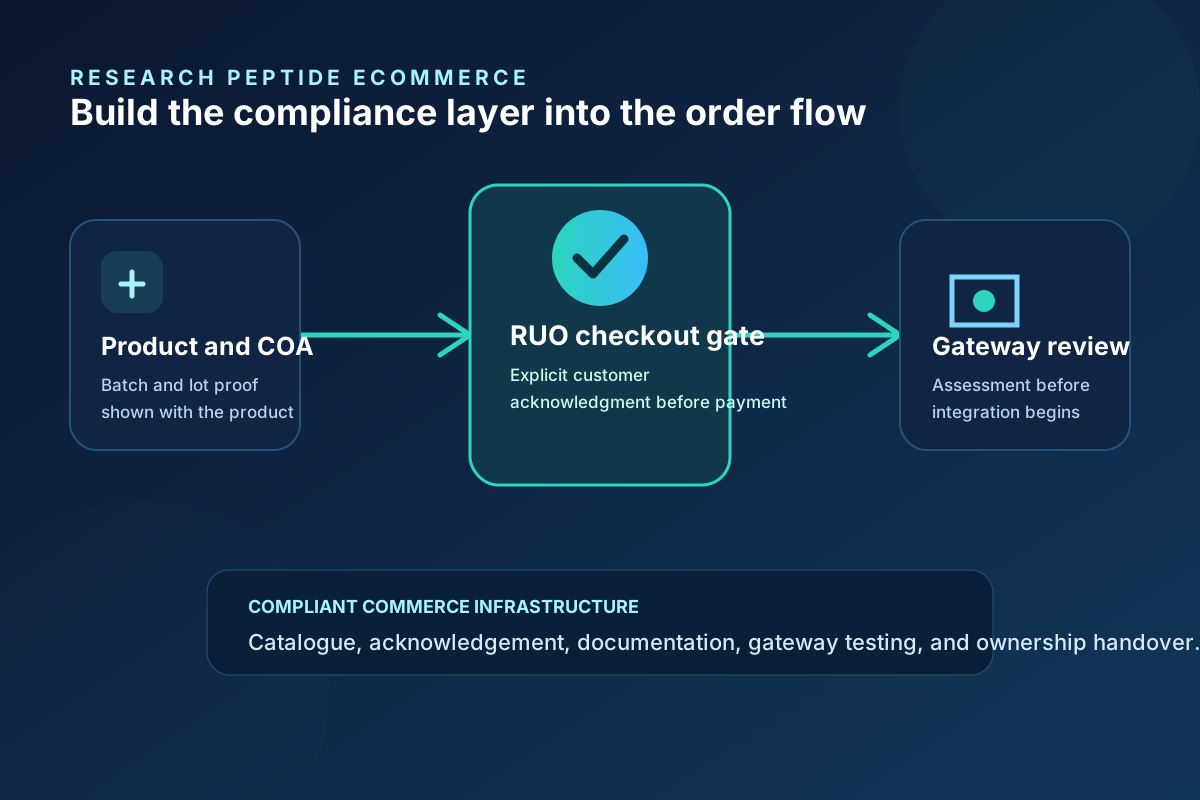
Make the Research Use Only acknowledgement a required part of checkout, not a buried footer disclaimer.
Traceable documentation
Tie COA information to products and batches so the right proof is available at the point of decision.
Operational ownership
Give the merchant control of routine catalogue, pricing, inventory, and order tasks after handover.
The architecture
Four connected decisions made the storefront repeatable
The exact stack can vary between a custom Next.js build and WordPress with WooCommerce. The important part is that the customer journey and the operator workflow agree on the same product, order, batch, and payment states.
Storefront and catalogue
A structured product catalogue, cart, product detail pages, and admin controls built around the merchant's catalogue rather than a generic template.
Compliance-aware checkout
Research Use Only language and explicit customer acknowledgment are part of the purchase flow, with the acknowledgement captured before payment is submitted.
Batch and COA proof
Certificate of Analysis documentation is connected to the relevant product batch and lot so customers can find the right proof without relying on a manual PDF folder.
Payment route built for the category
The checkout connects to an approved gateway path and keeps the payment state visible to the order workflow. Approval remains specific to each merchant and business.
How we delivered it
Build the risky parts before the pretty parts
The delivery sequence starts with category and gateway reality. That prevents a merchant from paying for a polished storefront before discovering that its checkout cannot support the business.
Assess the business
We review the product category, target market, catalogue, operating model, and realistic payment options before development begins.
Design the data flow
The store, order, RUO acknowledgement, product batch, COA, and gateway states are mapped before implementation.
Build and test the flow
The storefront, admin experience, checkout controls, and payment handoff are tested together rather than as disconnected features.
Hand over an owned system
The merchant receives the source code, documentation, and ownership of the project accounts and infrastructure.
What the work delivered
Repeatable delivery
Five RUO storefronts built with the same core lesson: gateway, acknowledgement, documentation, and order flow must be designed together.
Working payment experience
NowPayments and CCBill have been approved and integrated for this category. PayPal has worked for businesses that meet its specific guidelines.
Proof without private details
The portfolio demonstrates delivery experience without publishing customer order data, private business metrics, or confidential implementation details.
Important context: no developer can guarantee processor approval. Each gateway makes its own underwriting decision for each merchant. Our experience helps identify realistic options and build the checkout honestly, but it does not replace the processor's review.
Related service
Research Peptide Ecommerce Development
See the full service scope, process, and options for building a research peptide storefront.
Explore the serviceRelated guide
Peptide Payment Processor: What Actually Works
Read the practical payment-processing lessons from building five research peptide stores.
Read the guidePlanning a research peptide store?
Start with the payment and compliance constraints, then scope the storefront around them. We provide a written scope before billing begins.