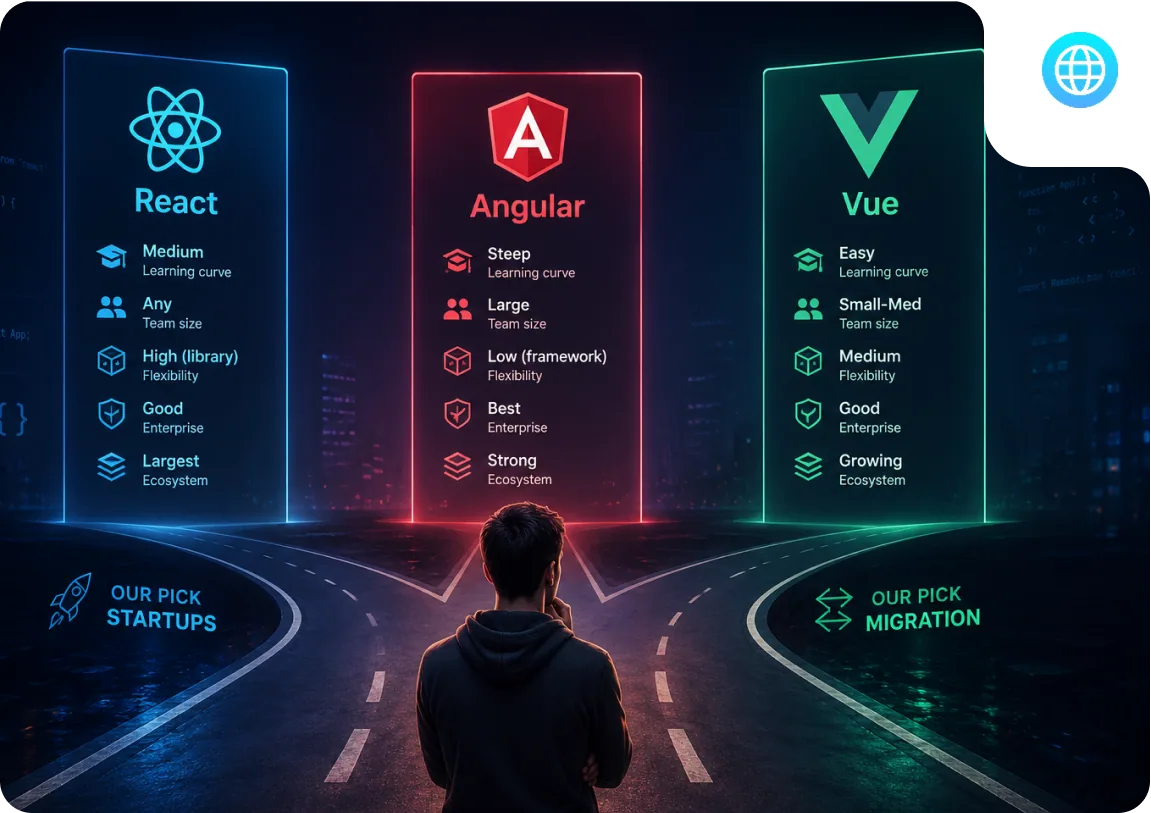
Updated: July 2026 (covers React 19, Angular 17-18 Signals, Vue 3 + Nuxt 3)
Every comparison article says 'it depends on your use case' and then gives you three pros and three cons per framework. That is not a recommendation. It is a way of avoiding the answer. We have built production applications in all three. Here is the actual recommendation, by project type, team size, and budget.
TL;DR:
- React: SaaS products, startups, apps needing a large talent pool.
- Angular: Enterprise software, large teams, long-lived applications.
- Vue: Mid-complexity projects, smaller teams, fast delivery requirements.
- Next.js (React): Full-stack web apps, SaaS with SSR, any project needing strong SEO.
- Nuxt (Vue): SSR for Vue projects, marketing sites, eCommerce frontends.
Quick Comparison, React vs Angular vs Vue
Before the detail, here is the side-by-side.
| Category | React | Angular | Vue |
|---|---|---|---|
| Created by | Facebook (Meta), 2013 | Google, 2016 | Evan You, 2014 |
| Type | UI Library (you add routing, state) | Full Framework (batteries included) | Progressive Framework (flexible) |
| Language | JavaScript or TypeScript | TypeScript (required) | JavaScript or TypeScript |
| Learning curve | Medium | Steep | Low to Medium |
| Developer usage (2024) | 43% of JS devs | 19% | 18% |
| Best for | SaaS, startups, product teams | Enterprise, large teams, banking/gov | Mid-complexity, small teams, eCommerce |
| SSR framework | Next.js | Angular Universal | Nuxt 3 |
| Job market | Very large | Large (enterprise) | Growing but smaller |
React, What It Is and When to Use It
React was released by Facebook in 2013. As of 2024, it is used by approximately 43% of JavaScript developers, making it the most widely adopted frontend library. React is technically a UI library, not a full framework, a distinction that matters because you build your own architecture around it using third-party packages for routing, state management, and data fetching.
What React is good at
React's component model is clean and predictable once understood. The Hooks API (useState, useEffect, useContext) provides a consistent pattern for managing component state and side effects. React 19 introduced Server Components and improved Actions that simplify data fetching and form handling significantly. The ecosystem is enormous, any problem you encounter has a well-maintained library solving it. The talent pool is the largest of the three frameworks, which matters when you need to hire.
We have built UltimaBot and UltimaWriter, both AI SaaS platforms, in React and Next.js. Steven has been our client since 2019. The React codebase has scaled with the product without requiring a framework change.
Where React creates friction
React's flexibility is also its main risk for less experienced teams. There is no single React way to do routing, state management, or data fetching. Teams that do not have senior React experience sometimes build themselves into architectural corners, inconsistent state patterns, prop drilling that becomes unmanageable, or server-client component boundaries that are not well defined. The framework does not prevent these mistakes. Experience does.
React's JSX syntax is also a genuine initial barrier for developers coming from Angular or traditional HTML templates. The shift in mental model takes time.
When to choose React
- Building a SaaS product where development speed and iteration matter
- Your team is small (2-8 developers) and comfortable with composing their own stack
- You need a large hiring pool for your engineering team in the next 12 to 24 months
- Your application will be paired with Next.js for full-stack capability and SEO
- You are building an AI-integrated application (React's ecosystem for AI UIs is strongest)
Angular, What It Is and When to Use It
Angular is Google's full frontend framework, rebuilt from scratch in 2016 as Angular 2 (dropping AngularJS 1.x). It is TypeScript-first, meaning TypeScript is not optional, it is how Angular applications are built. Angular includes routing, HTTP handling, forms, dependency injection, and a component testing framework out of the box. Angular 17 and 18 introduced Signals, a new reactive primitive that significantly reduces the complexity of state management compared to earlier RxJS-heavy patterns.
What Angular is good at
Angular's opinionated structure is its primary advantage for large teams. When 20 developers are working on the same codebase, Angular's conventions mean components, services, and modules follow predictable patterns regardless of who wrote them. This consistency reduces onboarding time for new team members and makes code review more efficient.
Angular's built-in dependency injection system makes testing straightforward, services can be mocked cleanly, components can be tested in isolation. For enterprise applications that will be maintained for 5 to 10 years, Angular's structure pays dividends over time.
Where Angular creates friction
Angular's learning curve is the steepest of the three frameworks. Modules, decorators, dependency injection, RxJS observables (still relevant despite Signals), and Angular's own CLI conventions require meaningful investment before a new developer is productive. For a small team building an MVP under time pressure, Angular's setup overhead is a genuine cost.
Angular applications also tend to take longer to build than equivalent React applications for small to medium projects, an estimation we factor into our quotes.
When to choose Angular
- Building enterprise software for a large organisation with 10+ developers
- Your application needs to be maintained for many years by rotating teams
- You are in a regulated industry (banking, government, insurance) where code consistency and auditability are requirements
- Your team already has Angular expertise and the learning curve is not a factor
- You need a full framework where architectural decisions are made for you
Vue, What It Is and When to Use It
Vue was created by Evan You in 2014, a former Google engineer who worked on AngularJS. Vue was designed to take what worked in Angular (template syntax, two-way binding) and what worked in React (component model, virtual DOM) and combine them into a framework with a gentler learning curve than either. Vue 3 introduced the Composition API, which brought Vue closer to React's programming model while keeping the template syntax that makes Vue approachable for developers coming from HTML/CSS backgrounds.
What Vue is good at
Vue's template syntax is the most readable of the three frameworks for developers who are not JavaScript-first. The separation of template, script, and styles in a single file component makes Vue easy to onboard. Vue's progressive adoption model is genuinely useful, you can add Vue to an existing server-rendered application without a full rewrite, which React and Angular make much harder.
Nuxt 3 (Vue's equivalent of Next.js) is a strong SSR and static site framework with excellent developer experience and growing adoption for eCommerce and marketing sites. For a development agency, Vue's faster iteration speed on mid-complexity projects makes it the most economical choice per deliverable for certain project types.
Where Vue creates friction
Vue's ecosystem, while healthy, is smaller than React's. Some categories, particularly AI-integrated UIs and complex state management solutions, have fewer Vue-specific options than their React equivalents. The hiring pool for senior Vue developers is smaller than for React, which matters if you plan to grow an engineering team. Vue's governance structure (community-driven, not backed by a large corporation) raises occasional concerns about long-term stability, though Vue 3 has addressed most of the maintenance concerns that surrounded the Vue 2 to Vue 3 migration.
When to choose Vue
- Mid-complexity projects where development speed matters more than ecosystem depth
- Smaller development teams (2-5 developers) where consensus on conventions is easy
- eCommerce frontends, content sites, or applications where Nuxt 3 SSR is relevant
- Incremental modernisation of an existing server-rendered application
- Projects where the development team has Vue expertise and React or Angular would require retraining
Which Framework for Which Project, The Honest Guide
The question is not which framework is technically best. The question is which framework is right for your specific situation. Here are our recommendations based on 14 years of building across all three.
Project Type 1, SaaS Product (startup or scale-up)
Recommendation: React with Next.js
Why: The largest talent pool for future hiring. Next.js handles SSR, API routes, and server components in one framework. React's ecosystem has the most mature SaaS component libraries. Most AI API integrations have React examples first. Cost at $30/hr: Faster initial development than Angular. Architecture investment upfront saves time at scale.
Project Type 2, Enterprise Web Application (large organisation)
Recommendation: Angular
Why: Angular's conventions scale across large teams without architectural drift. Built-in testing, dependency injection, and TypeScript requirement reduce the technical debt that accumulates when 20 developers make independent choices. The higher initial learning cost is recovered through long-term maintainability.
Project Type 3, eCommerce Frontend
Recommendation: Vue with Nuxt 3 or React with Next.js
Why: Both Nuxt 3 and Next.js deliver excellent SSR for eCommerce SEO requirements. Vue is a strong choice if the existing team has Vue experience. React is stronger if future team growth or a large third-party component library matters. Shopify Hydrogen (React-based) is the default for Shopify headless builds.
Project Type 4, Internal Business Tool or Dashboard
Recommendation: React or Angular depending on team size
Why: Internal tools do not have SEO requirements, so SSR matters less. React for smaller teams building their own dashboard. Angular for larger organisations that need standardised patterns across multiple internal tools. Vue is also a strong option here for faster delivery on clearly scoped requirements.
Project Type 5, Marketing Site or Content-Heavy Website
Recommendation: Next.js (React) or Nuxt 3 (Vue)
Why: Both provide static site generation and SSR for fast load times and SEO. Angular Universal exists but is less commonly used for marketing sites. If the site needs to be easily editable by a content team, pairing either with a headless CMS (Contentful, Sanity, Strapi) works well.
Project Type 6, Mobile App (companion to web)
Recommendation: React Native for the app, React for the web
Why: Sharing business logic and team expertise across web and mobile reduces total project cost. Angular and Vue do not have equivalent mobile frameworks with the same maturity as React Native.
See our React Native development servicesHow Framework Choice Affects Your Development Budget
Framework choice has a direct impact on development hours and therefore cost. At CV Infotech's rate of $30/hour, the difference between frameworks on a $30,000 project can shift the actual delivery by $3,000 to $6,000 either way.
| Factor | React | Angular vs React |
|---|---|---|
| Initial setup time | Low | Medium-High (15-25% more hours on small projects) |
| State management complexity | Low (hooks) | High (RxJS) / Medium (Signals) |
| Long-term maintenance cost | Medium (depends on architecture choices) | Lower (conventions enforced) |
| Hiring cost per developer | Market rate | Slightly higher (smaller pool) |
| Training cost for new developers | Medium | High (steepest curve) |
These are directional estimates, not fixed rules. A senior Angular developer who knows the framework deeply produces code faster than a junior React developer who does not. The framework recommendation we make during a discovery call accounts for your existing team expertise, not just the framework's theoretical properties.
Should You Use Next.js or Nuxt Instead?
Next.js and Nuxt are meta-frameworks built on top of React and Vue respectively. They add server-side rendering, static site generation, file-based routing, API routes, and production-ready defaults that the base frameworks do not include. For most production web applications, the question is not 'React or Vue' alone, it is 'Next.js or Nuxt or Angular.'
Next.js is the dominant full-stack React framework in 2026. CV Infotech's own site is built in Next.js 15 with App Router. If you are choosing React for a web application, Next.js is almost certainly the right way to use it. Nuxt 3 is the equivalent for Vue and has strong momentum for content-heavy and eCommerce applications. Angular does not have a meta-framework equivalent with the same adoption, Angular Universal handles SSR but is less commonly used than Next.js or Nuxt for new projects.
We build in Next.js 15 for React projects and Nuxt 3 for Vue projects. For Angular, we work in the framework directly.
Related Reading
Working on a React or Next.js project?
Written scope before billing. $30/hr. We tell you if we're not the right fit.

Akash Singh
View full profileCTO and Co-Founder, CV Infotech · Gurugram, India
Akash has been building Websites, Web Apps, SaaS and Mobile Apps for clients in the USA, Europe, Australia, and Canada since 2012. He leads a 100% in-house team and personally manages every client relationship and technical decision. Francisco Escobar has worked with him since 2012. Steven has trusted the team with his AI platforms since 2019. 512 verified 5.0 reviews on Freelancer.com.