E-commerce Improvements · SaaS & Integrations · Release Reliability. Discuss Your Improvement →
For support, lead and knowledge workflows

AI Chatbot Development Services

Give customers useful answers from knowledge you control.

CV Infotech develops custom AI chatbots for customer support, lead qualification and internal knowledge. Start with the questions users ask, the sources they can access and the next step when the chatbot cannot help. Evaluate a focused first release before extending its scope.

Bring sample questions, approved knowledge sources and the next step users need.

Selected work · UltimaBot
UltimaBot public AI communication-platform website
UltimaBot

CV Infotech developed UltimaBot, an AI communication platform bringing website chatbots, email campaigns and voice agents into shared lead-management workflows.

Relevant published work

A chatbot product developed by our team

Public project reference

CV Infotech developed UltimaBot. Its public product brings website chatbots, email campaigns and voice agents together around shared knowledge and lead-management workflows.

Explore UltimaBot →
UltimaBot→
AI COMMUNICATION SOFTWARE
SELECTED PRODUCT WORK

Chat. Email. Voice.
Shared context.

A communication product connecting website conversations, email campaigns and voice agents.

OUR ROLEProduct development by CV Infotech
PRODUCT IN FOCUS
ultimabot.ai · Public product preview→
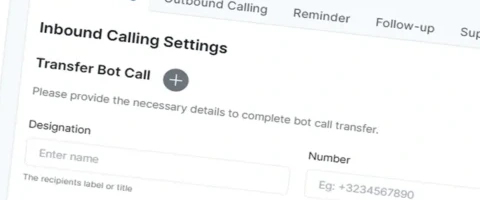
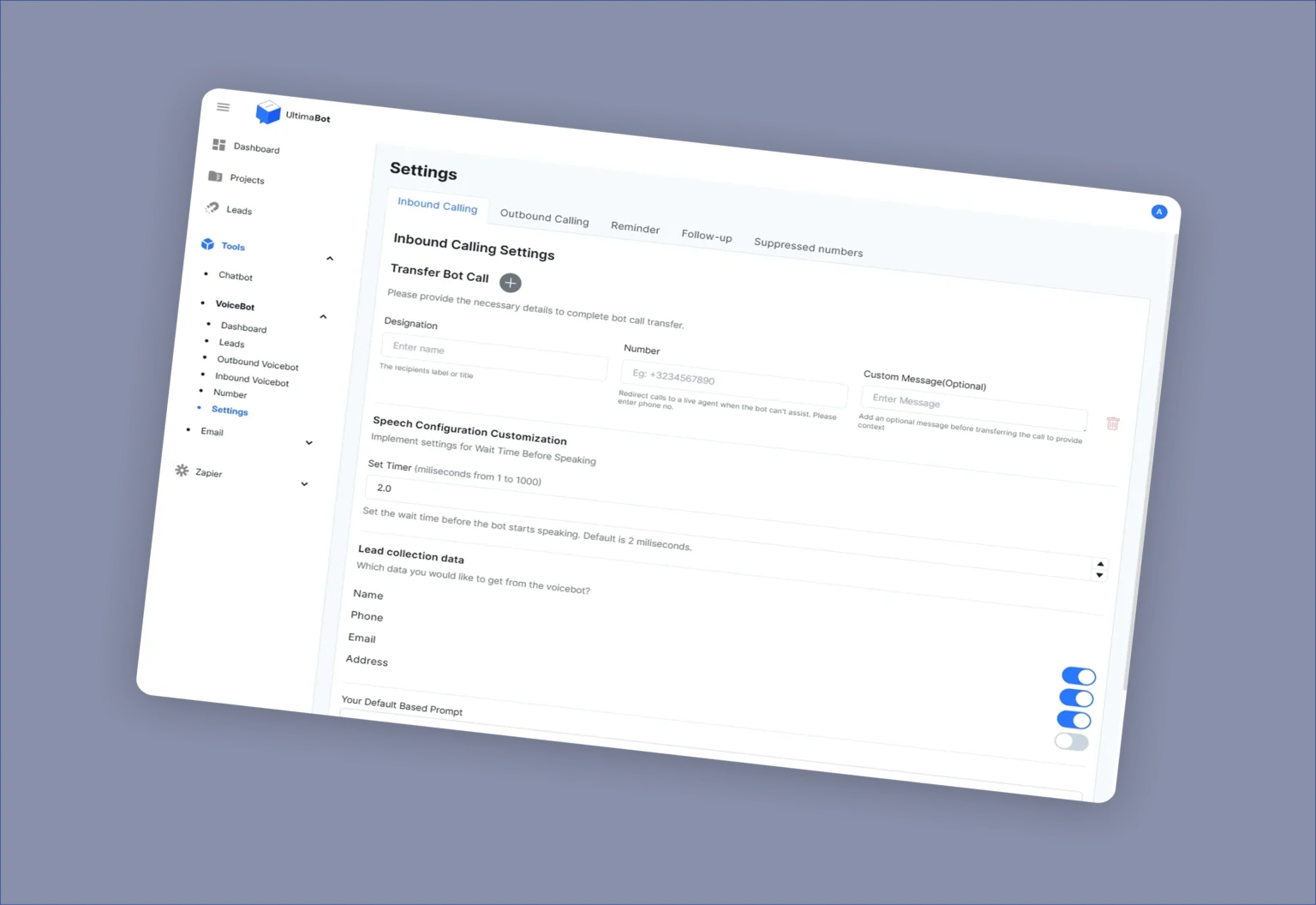
Actual UltimaBot inbound calling settings interface from its public website
Voice setup · Real product detail
Actual UltimaBot call-transfer configuration detail
∿
FEATURE SPOTLIGHTVoice agent setup
Voice settings and lead collection
Product capabilities

Converse

Website chatbots and voice agents

Connect

Inbound and outbound workflows

Continue

Shared knowledge and lead management

The agreed scope

Choose a customer-support, sales or knowledge chatbot

Customer support chatbot development

Help users find answers in approved help articles, product information and policies. Define which answers can be offered directly and which requests need account access or a support ticket. Return instructions, product limitations and troubleshooting steps need current source material and clear boundaries. A bot should acknowledge when the available information does not support an answer.

Lead qualification and enquiry handling

Guide a visitor through relevant questions, capture the details needed for follow-up and route the enquiry to the appropriate team. Agree the qualification rules and the information users must confirm before a record is created. CRM updates or meeting requests depend on the connected system's permissions and successful response.

Internal knowledge assistants

Make approved procedures and documentation easier to find through a conversational interface. Scope permissions before indexing: an assistant should only retrieve material the particular user is entitled to access. Decide who maintains the source content and how outdated, contradictory or removed documents are handled.

The agreed scope

Knowledge-base and RAG chatbot development

A retrieval-augmented generation, or RAG, system looks for relevant material in an approved knowledge collection and uses it to help produce a response. This can reduce unsupported answers and make relevant sources easier to inspect. It does not eliminate mistakes or guarantee that every answer follows the source correctly.

A useful design needs good documents, retrieval tests, answer evaluation and a way to decline or escalate unsupported requests. Documents can be incomplete; a retrieved passage can be irrelevant; an answer can misinterpret a correct passage. Evaluate those failure modes explicitly rather than treating retrieval as proof of accuracy.

Trace an answer from question to source

Retrieval and a fluent response are separate things to evaluate.

  1. 01Check context and access

    Identify the request and restrict retrieval to material that the user may access.

  2. 02Retrieve approved information

    Find relevant, current sources and recognise missing or conflicting content.

  3. 03Answer or clarify

    Offer a supported answer with useful references, or ask a focused question when the task is unclear.

  4. 04Escalate and review

    Use the approved human-help route for unsupported requests and record suitable evidence for improvement.

Illustrative workflow for scoping. The final stages and responsibilities depend on your project.

Validate actions before changing a system

If a conversation requests an action, add validation and confirmation before the system attempts it. An order lookup, ticket creation or account update should have defined permissions and failure handling. A model's proposed answer is not evidence that the external action succeeded.

Plan your project

Scope knowledge access, integrations and human help

Knowledge management. Agree source ownership, ingestion, updates, deletion and permission-aware retrieval. Define how the team can identify content gaps and test a change before relying on it.

Conversation and escalation. Design clarification questions, out-of-scope responses and a realistic human-help route. That route might create a ticket or provide a contact option. Live handoff requires a compatible platform, available staff and a tested fallback when nobody is available.

Channels and integrations. Assess website chat, in-app messaging, WhatsApp or Slack against your audience, account permissions and provider requirements. Start with the channel that completes the chosen workflow. Additional channels can introduce different identity, formatting and conversation-history requirements.

Evaluation and operation. Choose representative questions, ambiguous requests and misuse attempts. Review groundedness, task completion, access-control behaviour, fallback quality, response time and usage cost. Agree what records may be retained and who reviews problems after launch.

Plan your project

When a custom AI chatbot is the right fit

A custom assistant is worth considering when users ask varied questions across a substantial knowledge collection or need a guided workflow connected to your product. It works best with an accountable content owner and realistic acceptance criteria.

A searchable help centre, structured form or rule-based conversation may be sufficient for a small, predictable task. Where answers require sensitive judgement, define human responsibility before considering automation. Call-based interactions belong with AI voice-agent development; broader model integration belongs with AI development services.

Plan your project

From chatbot prototype to an evaluated release

Begin with a use-case brief and a representative evaluation set. Review the content and permissions, then test a prototype against the agreed requirements. Implement the selected interface and connections after the feasibility work identifies a useful path.

Depending on the proposal, deliverables can include a conversation specification, retrieval configuration, chatbot interface, approved integrations, evaluation results and a handover guide. Define deployment approval, monitoring responsibilities, support coverage and recurring provider costs separately. A wider subscription platform can also require SaaS development.

Explore your starting point

Define what your chatbot may use and do

Each use case needs a different boundary around knowledge, identity and actions.

Who is the assistant helping?

Visitors asking public support questions

Begin with approved public help content and a clear route when the answer is missing.

  • Identify the source owner and update process
  • Prepare typical and unanswerable questions
  • Agree source references and escalation wording
Staff looking up internal knowledge

Permission-aware access is a core requirement, including documents that change or are removed.

  • Map user groups to allowed sources
  • Test restricted, outdated and conflicting documents
  • Agree retention and content-removal behaviour
Visitors completing a sales enquiry

Separate answering questions from creating records or requesting a meeting. Every action needs its own validation.

  • Define necessary fields and qualification rules
  • Confirm information before a permitted update
  • Test duplicate requests and failed CRM actions

Illustrative scoping guide. Each choice reveals a fixed checklist; it does not inspect your systems, calculate a score or estimate a quote.

Before you start

AI chatbot development questions

Does our data train the underlying model?

A knowledge-base implementation commonly retrieves your documents at question time rather than retraining the model. Data use, retention and provider settings still require review. Agree which information may be processed and where before choosing the architecture.

Can it work with our CRM or help desk?

Share the system and exact workflow. We assess APIs, permissions and account requirements before committing to a connection. Creating a ticket and changing an account record have different risks and acceptance criteria.

What affects AI chatbot development cost and timing?

Content readiness, user permissions, channels, integrations and evaluation requirements determine the scope. Model usage, hosting and support affect ongoing cost. Share your budget range and target date so the first release can be bounded sensibly.

Can it avoid incorrect answers completely?

No AI system can be promised error-free answers. Approved sources, retrieval testing, validation and well-designed fallbacks can reduce risk. Agree acceptable behaviour for missing or conflicting evidence and test it before deployment.

How do we keep it useful after launch?

Assign ownership for source updates, evaluation changes and operational review. Retest material changes to prompts, models, retrieval settings or content. Maintenance and support commitments should be written into the agreed scope.

Start with a focused conversation

Describe one conversation you want to improve

Tell us who will use the chatbot, the questions they ask, the sources it should consult and the next step when it cannot help. Include required channels, connected systems, budget range and target date.

Send fictional questions or public documentation. Please do not include credentials, private employee documents or customer conversation logs in the initial enquiry.

Discuss my chatbot workflow