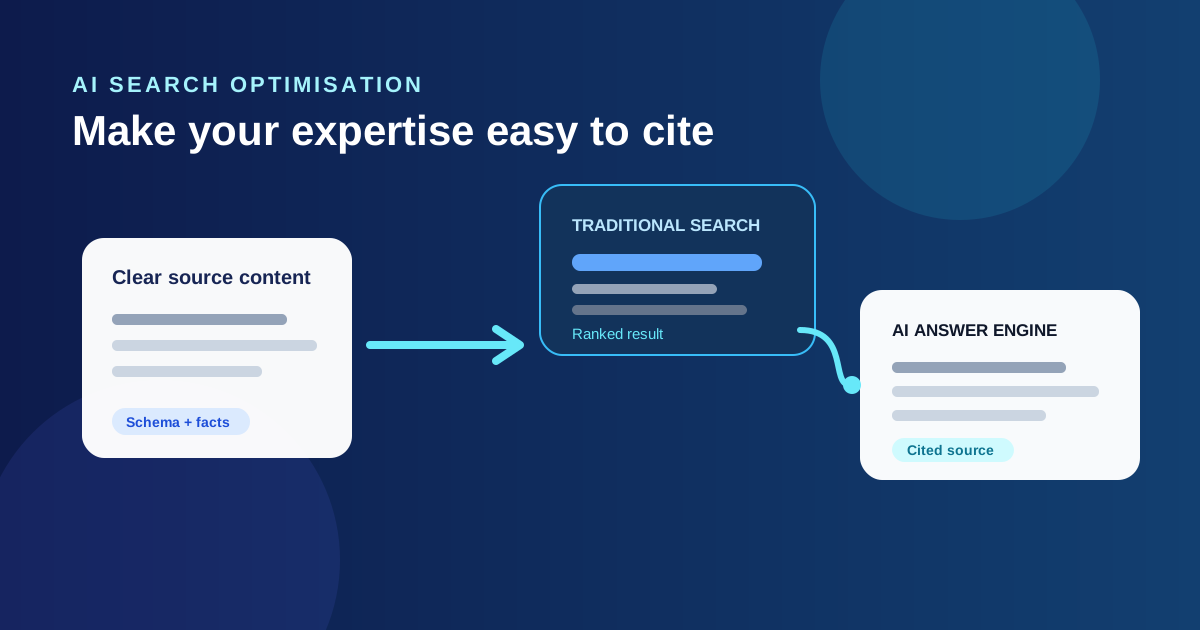
If your SEO strategy still begins and ends with getting a blue link higher in Google, you are optimising for only part of how people now find answers. AI systems increasingly decide which sources to quote before a person visits a results page at all.
What AI Search Optimisation Actually Is
AI search optimisation is the practice of making content easy for answer engines to understand, trust, and cite. You may also hear it called generative engine optimisation (GEO), answer engine optimisation, or AI visibility. The naming debate is still active, as Search Engine Land has documented , but the practical shift is clear.
Instead of only asking “how do we rank?”, the new question is “when someone asks an AI a useful question in our category, is there a clean, credible reason for it to use our content in the answer?”
Ranking Is Not the Same as Citation
Traditional SEO
Optimises a page to appear prominently in a list of links. The person chooses whether to click.
AI search optimisation
Optimises a page so an answer engine can extract and cite a specific useful claim directly in its response.
Those goals overlap, but they are not identical. A page can rank well while still being hard for an AI system to quote because its most useful answer is buried, vague, or unsupported. Equally, a short, specific, well-structured answer can earn a citation even when it is not the highest-ranking traditional result.
What Actually Makes Content Easier to Cite
There is no magic tag that forces an AI citation. The work is more disciplined than that:
- Answer the question early. Put a clear definition or conclusion near the top of the relevant section.
- Use specific facts. Named tools, dates, limitations, and process details give systems something concrete to use.
- Structure information cleanly. Headings, lists, Article schema, and genuine FAQ markup reduce ambiguity.
- Show real experience. Content that reads like it came from work actually done is more useful than generic summaries.
Google’s own guidance for AI features reinforces the useful part: make content helpful, reliable, and technically accessible, rather than trying to manufacture a separate kind of “AI content.” Read Google’s AI features guidance .
Working on a AI search optimisation project?
Written scope before billing. $30/hr. We tell you if we're not the right fit.
How This Differs From AI SEO
AI SEO is a broader operational term. It describes using AI for keyword research, content-gap analysis, technical monitoring, and other SEO work. AI search optimisation is narrower: it is about how your published pages perform inside AI-generated answers.
They complement each other. AI can make a team’s SEO process faster; GEO makes sure the content that process produces is also ready for answer engines. Treating them as the same thing hides an important practical difference.
A Practical Starting Point
Start with the pages where a potential customer is most likely to ask a question before making contact: service explainers, comparison pages, buying guides, and FAQs. Audit whether each page gives a direct, specific answer, names the evidence behind it, and uses structured data honestly.
Do not create duplicate pages just to chase every new label. Improve the useful content you already own, then publish new pages only where there is a genuine unanswered question. That is good traditional SEO and good AI search optimisation at the same time.

Akash Singh
View full profileCTO and Co-Founder, CV Infotech · Gurugram, India
Akash has been building Websites, Web Apps, SaaS and Mobile Apps for clients in the USA, Europe, Australia, and Canada since 2012. He leads a 100% in-house team and personally manages every client relationship and technical decision. Francisco Escobar has worked with him since 2012. Steven has trusted the team with his AI platforms since 2019. 512 verified 5.0 reviews on Freelancer.com.