Most crypto trading bot development pages read the same way: a list of features like backtesting, arbitrage, and AI-powered strategies, followed by a contact form. What is missing from almost all of them is the part that actually determines whether a bot works reliably or quietly loses money.
Why Backtesting Results Rarely Match Live Performance
Slippage is not optional to model
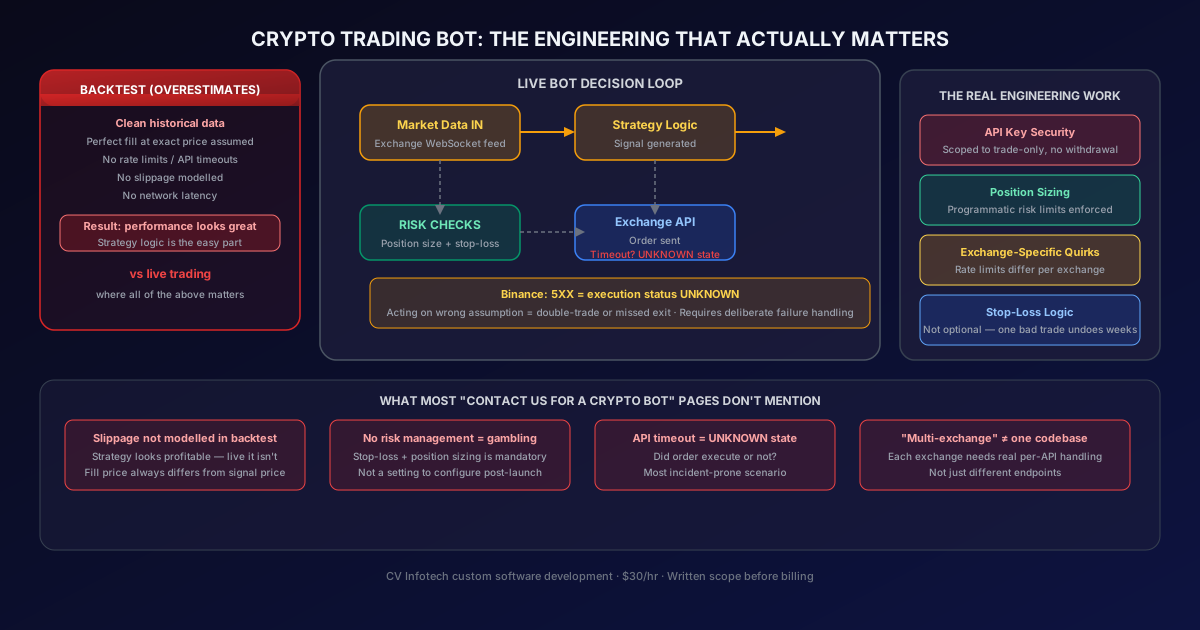
A strategy that looks profitable in a backtest often assumes you get filled at the exact price you wanted. Real exchanges have slippage, the price moves between when your bot decides to trade and when the order actually executes, and a backtest that does not model this realistically will overstate performance every time.
Backtests do not experience API rate limits or downtime
A backtest runs against clean historical data with no interruptions. A live bot has to handle exchange API rate limits, occasional downtime, and network latency, all of which can mean a signal your strategy generated never actually gets executed in time, a failure mode that simply does not exist in a backtest.
The Part Most Agencies Skip: Risk Management
Position sizing and stop-loss logic are not optional
A trading strategy without disciplined position sizing and stop-loss logic is not really a trading bot, it is a bet with extra steps. Building this properly means the bot enforces risk limits programmatically, not as a setting someone might forget to check, since a single bad trade without a stop-loss can undo weeks of otherwise sound performance.
What happens when the exchange API fails mid-trade
A genuinely robust bot needs to handle the case where an order request times out: did it execute or not? Binance's API documentation explicitly notes that a 5XX response means "execution status UNKNOWN," not failure. Acting on the wrong assumption either way can mean double-executing a trade or missing an exit you needed.
Working on a custom trading bot and software development project?
Written scope before billing. $30/hr. We tell you if we're not the right fit.
Security: API Keys Are the Actual Attack Surface
A trading bot needs API keys with trading permissions on a live exchange account, which makes key security a genuinely serious concern, not a checkbox. Keys need to be scoped to only the permissions the bot actually needs, ideally excluding withdrawal permissions entirely, and stored with the same discipline you would apply to any other high-value credential, since a leaked key with trading and withdrawal access is a direct path to a real financial loss. Nadcab Labs' technical guide on trading bot risk management covers position sizing, stop-loss design, and execution risk handling in depth.
Exchange-Specific Quirks That Break Naive Implementations
Every exchange's API has its own quirks, rate limit structures, order type support, and websocket reliability characteristics, and a bot built against one exchange's API often does not port cleanly to another without real adaptation work. Generic "multi-exchange" claims on a service page are worth scrutinising specifically for how much real per-exchange handling actually exists underneath that claim.
The Reality of Building This Well
The strategy logic, the part most marketing pages emphasise, is often the smallest piece of the actual engineering effort. Risk management, failure handling, exchange-specific integration work, and API key security together represent the majority of what separates a bot that survives live trading from one that looks good in a demo and breaks under real conditions.
Where We Fit
If you are building a simple bot for personal use on a single exchange with modest capital at risk, a straightforward implementation may be all you need. Where we come in is for bots that need real risk management, multi-exchange reliability, and security discipline built in from the start, not added after something has already gone wrong. That is the same engineering discipline behind our custom software development work, $30 an hour, written scope before any billing starts.

Akash Singh
View full profileCTO and Co-Founder, CV Infotech · Gurugram, India
Akash has been building Websites, Web Apps, SaaS and Mobile Apps for clients in the USA, Europe, Australia, and Canada since 2012. He leads a 100% in-house team and personally manages every client relationship and technical decision. Francisco Escobar has worked with him since 2012. Steven has trusted the team with his AI platforms since 2019. 512 verified 5.0 reviews on Freelancer.com.