The Core Architectural Difference
OpenCart: built for ecommerce specifically
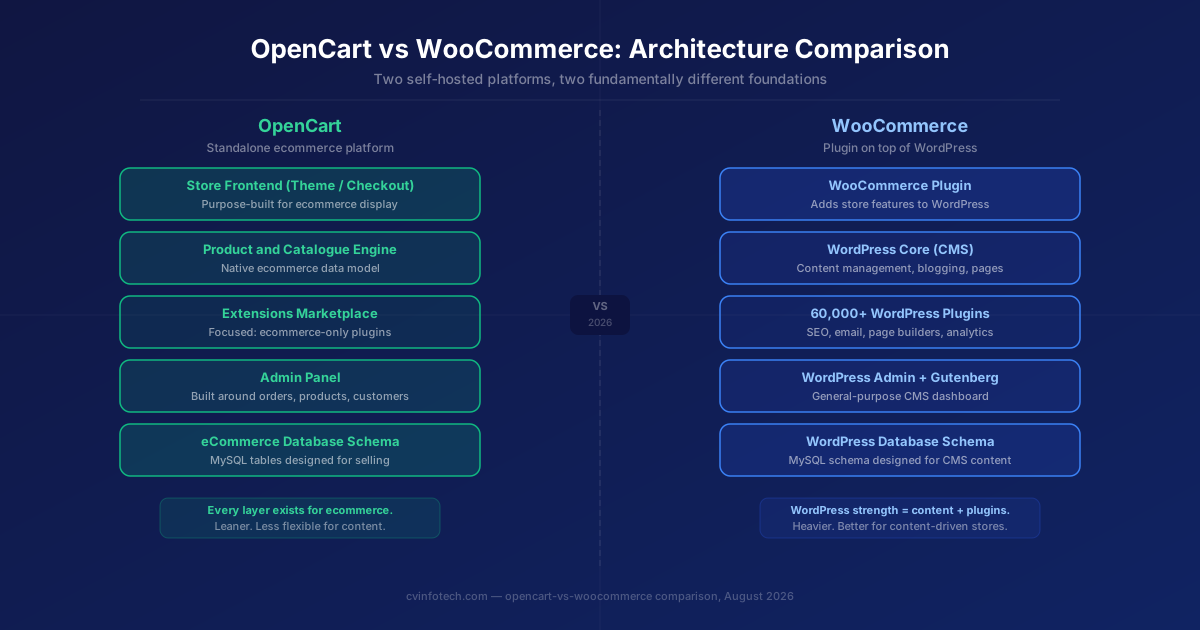
OpenCart was designed as a dedicated ecommerce platform from day one. Every part of its structure, the admin panel, the database schema, the default theme system, is built around selling products. This makes it lightweight and fast for pure ecommerce use cases, but less flexible if you also want to run a substantial content site, blog, or resource library alongside your store.
There's an active discussion on OpenCart's official forum covering platform scalability approaches, which gives a useful view of how OpenCart merchants handle growth at the architecture level.
WooCommerce: ecommerce bolted onto a content platform
WooCommerce takes the opposite approach. It's a plugin on top of WordPress, which means you inherit WordPress's entire content management strength, blogging, page building, an enormous plugin ecosystem, but ecommerce isn't the platform's native purpose, it's added functionality. For stores where content marketing matters as much as the product catalogue, this can be a genuine advantage.
Ecosystem and Extensions
OpenCart's extension marketplace
OpenCart has its own dedicated marketplace for extensions and themes, focused specifically on ecommerce functionality. It's smaller than WordPress's plugin ecosystem overall, but everything in it is at least relevant to running a store, there's less noise to filter through. See our OpenCart development page for details on what we build when the marketplace doesn't have what you need.
WooCommerce's plugin advantage
WooCommerce benefits from the entire WordPress plugin ecosystem, tens of thousands of plugins, most of which have nothing to do with ecommerce specifically but many of which genuinely help a business, SEO plugins, email marketing integrations, page builders. If you want your store to also function as a strong content and marketing site, this ecosystem depth is hard for OpenCart to match.
Working on a OpenCart or WooCommerce development project?
Written scope before billing. $30/hr. We tell you if we're not the right fit.
Performance and Resource Requirements
OpenCart's lightweight, purpose-built structure generally means lower server resource requirements for a comparable store size, it doesn't carry the overhead of a full CMS underneath it.
An independent performance comparison between OpenCart and WooCommerce installations confirms this pattern: at equivalent catalogue sizes and plugin/extension loads, OpenCart typically shows lower Time to First Byte and memory usage. The gap narrows significantly with proper WooCommerce caching configuration, but the underlying architecture difference doesn't disappear.
WooCommerce, running on top of WordPress, can become resource-heavy as more plugins accumulate, WordPress's flexibility is also what makes it easier to slow down if it's not managed carefully.
Which Platform Fits Which Business
If your website is primarily a store with minimal need for a blog or content marketing, OpenCart's focused structure is a reasonable fit and tends to run leaner. If content marketing, SEO-driven blog content, or a broader web presence beyond the store itself matters to your business, WooCommerce's WordPress foundation gives you that in a way OpenCart genuinely doesn't match natively.
Neither answer is universally correct, and we'd rather tell a client honestly which one fits their specific situation than push whichever platform we happen to have more current capacity to build on.
The Reality of Migrating Between Them
Moving from OpenCart to WooCommerce, or the reverse, isn't a simple export-import process. Product data, customer records, and order history all need careful mapping between two genuinely different database structures, and theme or extension functionality on one platform rarely has a direct equivalent on the other, custom logic often needs to be rebuilt rather than transferred. This is one of the more underestimated scopes in ecommerce development, and it's where cutting corners on data handling tends to surface months later as missing order history or broken redirects.
Where We Fit
If you're comfortable evaluating your own content needs versus pure ecommerce focus and choosing based on that, this decision doesn't require us. Where we come in is for stores that need an honest technical assessment of which platform actually fits their specific catalogue, content strategy, and growth plans, or for migrations between the two that need careful data handling to avoid losing history in the process.
That's the same expertise behind our dedicated OpenCart development and WordPress and WooCommerce customisation work, $30 an hour, written scope before any billing starts.

Akash Singh
View full profileCTO and Co-Founder, CV Infotech · Gurugram, India
Akash has been building Websites, Web Apps, SaaS and Mobile Apps for clients in the USA, Europe, Australia, and Canada since 2012. He leads a 100% in-house team and personally manages every client relationship and technical decision. Francisco Escobar has worked with him since 2012. Steven has trusted the team with his AI platforms since 2019. 512 verified 5.0 reviews on Freelancer.com.