CV Infotech has been building WooCommerce stores since 2012. Francisco Escobar's WooCommerce infrastructure has been running without payment processing failures for 14 years. These prices come from actual project invoices at $30 per hour, not from survey aggregators.
Most WooCommerce cost guides quote ranges so wide they are useless. Somewhere between $500 and $50,000 tells you nothing about what your specific store will cost, who will build it, or why the gap exists.
The gap exists because WooCommerce is both the simplest and the most complex eCommerce platform in the world, depending on what you ask it to do. A basic store with a premium theme and Stripe integration is a very different build from a multi-vendor B2B marketplace with wholesale pricing tiers, ERP synchronisation, and a custom checkout flow. They are both WooCommerce. They are not the same project.
Every price here is based on CV Infotech's $30 per hour rate. I have included US and UK agency comparisons where they are relevant. The cost difference is not because Indian developers are less capable. It is because the cost of living difference allows Indian agencies to operate at a different price point for the same output quality.
What a WooCommerce Project Actually Covers
WooCommerce is a free, open-source eCommerce plugin for WordPress. The plugin itself costs nothing to install. The project cost comes from everything required to turn a blank WordPress installation into a functional, branded, and tested online store: theme design or customisation, payment gateway integration, product configuration, shipping logic, third-party service connections, performance optimisation, and launch testing.
WooCommerce is the right platform when you need one of the following:
- Full ownership of your store and data without recurring platform fees
- Custom checkout flows, pricing logic, or product types that hosted platforms cannot accommodate
- B2B or wholesale pricing with customer-group-specific price lists
- Deep integration with an existing WordPress content site
- A multi-vendor marketplace where vendors manage their own products and payouts
WooCommerce versus Shopify is a platform decision that affects cost at every tier:
| Factor | WooCommerce | Shopify |
|---|---|---|
| Platform cost | Free (open source) | $39 to $399/month |
| Transaction fees | None | 0.5 to 2% (non-Shopify Payments) |
| Customisation ceiling | Unlimited (open source) | Limited by platform APIs |
| B2B / Wholesale | Via WC B2B plugins | Shopify Plus only ($2,000+/mo) |
| Hosting | Your responsibility ($20 to $150/mo) | Included in plan |
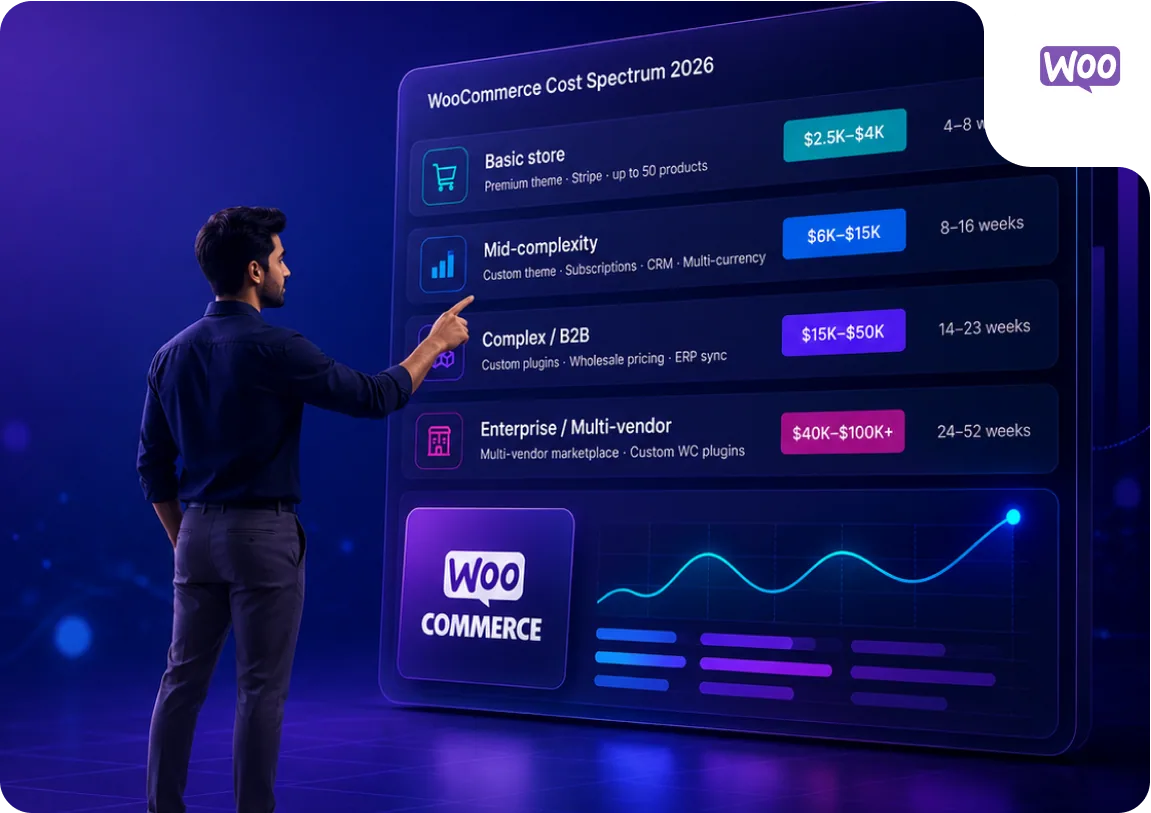
The Four Cost Tiers
Basic store
Premium theme · Stripe · up to 50 products
$2,500 to $6,000
4 to 8 weeks
Premium theme installation and customisation, one payment gateway (Stripe or PayPal via the official WooCommerce plugins), up to 50 simple products, basic shipping zones, standard WooCommerce checkout, and a Google Analytics integration. No custom development. Suitable for a first store or a simple catalogue with straightforward fulfilment.
Mid-complexity store
Custom theme · Subscriptions · CRM · Multi-currency
$6,000 to $18,000
8 to 16 weeks
Custom theme design and development from a mockup, subscription products with the WooCommerce Subscriptions extension, multi-currency with automatic rate updates, CRM or email platform integration, variable products with multiple attribute sets, and custom checkout field or checkout flow modifications. Suitable for businesses with a specific brand requirement or complex product catalogue.
Complex / B2B store
Custom plugins · Wholesale pricing · ERP integration
$15,000 to $50,000
14 to 28 weeks
Custom WooCommerce plugins developed from scratch, B2B wholesale pricing with customer-group-specific price lists, ERP or accounting system synchronisation via custom API, complex shipping logic with carrier API integrations, tiered loyalty programmes, and custom order management workflows. Requires a development team with WooCommerce plugin development experience, not just theme customisation experience.
Enterprise / Multi-vendor
Multi-vendor marketplace · Custom WC plugins
$40,000 to $100,000+
24 to 52 weeks
Multi-vendor marketplace with vendor dashboards, commission splits, and payout management (using WC Vendors or Dokan as a base), or a large catalogue store with tens of thousands of products requiring optimised database queries and infrastructure. These projects require senior WooCommerce development with architecture-level decision-making, not template customisation.
What Drives the Cost Up
When a WooCommerce quote comes in higher than expected, one of these factors is almost always the reason. When a quote comes in suspiciously low, one of these has been underestimated.
Custom theme vs premium theme
A custom WooCommerce theme designed from a Figma mockup costs 3 to 5 times more than customising a premium theme from ThemeForest or the Astra ecosystem. For most stores, a well-customised premium theme delivers the visual result at a fraction of the custom design cost. Custom themes are justified when the brand requires interaction design that no premium theme can accommodate, or when performance requirements demand removing the theme framework overhead entirely.
Payment gateway complexity
The official WooCommerce plugin for Stripe handles standard card payments (Stripe charges 2.9% + 30c per transaction on its standard plan — see the full breakdown on the Stripe pricing page). Integrating a local payment gateway in Australia, the UK, or continental Europe that does not have a maintained WooCommerce plugin requires custom API work. Each non-standard gateway adds 20 to 60 hours of development time.
Product type complexity
Simple products are quick to configure. Variable products with multiple attributes (size, colour, material) and hundreds of variants require careful attribute configuration and testing. Subscription products with trial periods, pause logic, and proration require the WooCommerce Subscriptions extension and additional QA time. Bundle products that affect stock levels across multiple component products add further configuration scope.
Third-party system integrations
Each integration (CRM, email platform, accounting system, shipping carrier, loyalty programme) requires specification, API authentication, data mapping, error handling, and testing. A well-maintained WooCommerce plugin for a popular system (Mailchimp, HubSpot, Xero) costs less to integrate than a custom API connection to a system with no existing plugin. Budget 15 to 40 hours per integration as a baseline.
Post-launch scope creep
The most consistent cost driver across all WooCommerce projects is scope that was not defined upfront. A development quote without a written deliverables list is an invitation for scope disagreements. Additions that appear small — a second currency, a custom checkout field, a new shipping logic rule — each require development, testing, and QA that was not in the original estimate.
Ongoing Costs After Launch
WooCommerce is free to install, but operating a WooCommerce store carries recurring costs that most initial build quotes exclude. These are the costs that consistently surprise first-time store owners in year two.
| Cost item | Annual range | Notes |
|---|---|---|
| Managed WordPress hosting | $240 to $1,800/yr | Kinsta, WP Engine, Pressable |
| Premium plugins (annual renewals) | $200 to $1,500/yr | Subscriptions, WooCommerce Bookings, etc. |
| SSL certificate | Free (Let's Encrypt) | Included on most managed hosts |
| Security monitoring | $100 to $500/yr | Wordfence, Sucuri, or equivalent |
| Developer maintenance retainer | $240 to $1,200/yr at $30/hr | Updates, bug fixes, minor changes |
The total recurring cost of a well-maintained WooCommerce store is typically $1,000 to $5,000 per year, depending on the plugin stack, hosting tier, and how much ongoing development work is needed. This is consistent with published figures from WooCommerce.com on the typical annual operating cost of a production WooCommerce store.
Why Building In-House Is More Expensive Than It Looks
Many businesses explore managing their WooCommerce build with an in-house developer or a freelancer found on a marketplace. Both paths are cheaper on paper and more expensive in practice.
| Cost element | Freelancer / US dev | CV Infotech ($30/hr) |
|---|---|---|
| Hourly rate | $80 to $200/hr (US/UK) | $30/hr |
| WooCommerce plugin experience | Variable, unverified | 14 years, 512 reviews |
| Design + QA + development | Separate hires required | One team, one contract |
| Written scope before billing | Often not provided | Always included |
| Scope creep risk | High without written scope | Controlled via written spec |
The most common outcome of a low-rate freelancer engagement is a partially built store that requires a second agency to complete at full cost. The total bill is higher than hiring a specialist WooCommerce agency from the start. We see this regularly on discovery calls.
The cost savings at $30/hr versus $100 to $150/hr at a UK or US agency are real, not a quality trade-off. Gurugram has a deep pool of senior WooCommerce developers. The rate difference is a cost of living difference, not a capability difference.
Working on a WooCommerce project?
Written scope before billing. $30/hr. We tell you if we're not the right fit.
How CV Infotech Approaches This
We have been building WooCommerce stores since 2012. Francisco Escobar's store has been running on our infrastructure for 14 years without a payment processing failure. Every project we quote starts with a written scope document: a deliverables list, a fixed price, and a timeline, before any development begins.
- Written deliverables list and fixed price before work starts. No verbal agreements.
- Sprint-based delivery with a working build on your staging environment at the end of every two weeks.
- Direct communication with the lead developer throughout the project.
- 30-day post-launch support included for bugs found after launch.
- Maintenance retainer available at $30/hr covering plugin updates, security patches, and minor changes.

Akash Singh
View full profileCTO and Co-Founder, CV Infotech · Gurugram, India
Akash has been building Websites, Web Apps, SaaS and Mobile Apps for clients in the USA, Europe, Australia, and Canada since 2012. He leads a 100% in-house team and personally manages every client relationship and technical decision. Francisco Escobar has worked with him since 2012. Steven has trusted the team with his AI platforms since 2019. 512 verified 5.0 reviews on Freelancer.com.