Clutch 5.0 · 35 Verified Reviews · 12,000+ Projects Delivered, Get a Free Quote →
AI Development

AI Agents for Business: What They Actually Do and When You Need One

AI agent adoption is accelerating, but so is confusion about what an agent actually is versus a chatbot. Here's what agents genuinely do, where they fall short, and how to implement one safely.

10 min read

We've built and maintained AI agent systems since 2019 across UltimaBot and UltimaWriter. The implementation advice in this post comes from that real-world production experience.

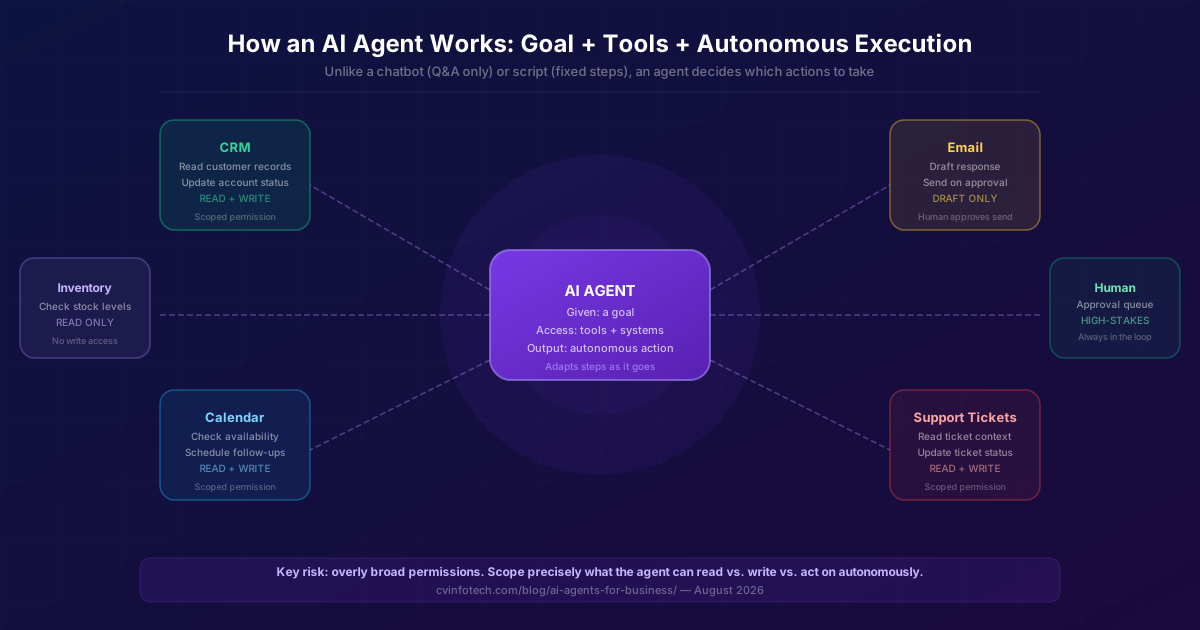
Diagram showing an AI agent connected to business systems and executing tasks autonomously.
How an AI agent connects to business systems with scoped permissions. Diagram: CV Infotech.

"AI agent" has become one of those terms that gets used for almost anything with a chatbot interface, which makes it genuinely hard to tell what you'd actually be buying if you decided to add one to your business. According to IDC's FutureScape predictions, 40% of large enterprise job roles will involve working with AI agents by 2026, with a 10x increase in agent usage expected.

That's a real shift, not hype, but it's also a shift happening alongside a lot of vague marketing that blurs what an agent actually does versus a simple chatbot or automation script.

This post cuts through that ambiguity. We'll define what actually makes something an AI agent rather than just an AI-powered feature, walk through where agents genuinely save businesses time versus where the hype outpaces the reality, and cover what it actually takes to implement one properly.

What Actually Is an AI Agent?

Agent versus chatbot versus automation

A chatbot answers questions within a defined conversation. A traditional automation script executes a fixed sequence of steps you programmed in advance. An AI agent sits between these: it's given a goal, has access to specific tools or systems, and decides for itself which steps to take to accomplish that goal, adapting as it goes rather than following a fixed script.

Why this distinction actually matters for a business decision

If a vendor calls something an "AI agent" but it's really a chatbot with a friendlier name, you're not getting the autonomous, multi-step task execution that's the actual value proposition of agents. Knowing this distinction before you buy is the difference between getting genuine automation and getting a slightly fancier FAQ widget.

Where AI Agents Genuinely Help a Business

Repetitive, multi-step tasks with clear rules

Agents work best on tasks that involve several steps across different systems but follow reasonably consistent logic, processing a support ticket by checking an order status, updating a CRM record, and drafting a response, for example. The more the task resembles "look something up, make a decision based on rules, take an action," the better an agent tends to perform.

Where agents still fall short

Tasks requiring genuine judgement calls with high stakes, tasks where the rules are frequently ambiguous or contradictory, or tasks where a mistake is expensive to undo, are still risky to hand fully to an agent without a human check in the loop.

Gartner's research on agentic AI projects projects that over 40% of agentic AI projects will be cancelled by the end of 2027, largely due to unclear ROI and high implementation costs, a useful reality check against the more breathless agent marketing out there.

Working on a AI agent scoping and implementation project?

Written scope before billing. $30/hr. We tell you if we're not the right fit.

Talk to Our AI Team

What Implementing an AI Agent Actually Involves

Scoping what the agent can and can't touch

The single most important decision in any agent implementation is defining its permissions precisely, what systems it can read from, what it can write to, and what actions require human approval before executing. Getting this wrong is how agents cause real damage, an agent with overly broad permissions acting on an ambiguous instruction is a genuine risk, not a hypothetical one.

Integration with existing business systems

An agent is only as useful as the systems it can actually connect to, your CRM, your support ticketing system, your inventory database. This integration work is frequently underestimated in agent implementation timelines, connecting cleanly to real business systems with proper error handling takes meaningfully longer than the demo version of any agent platform suggests.

The Reality of Building This In-House

Most businesses evaluating AI agents don't have someone whose primary job is agent architecture, scoping permissions correctly, testing edge cases, and building the integration layer to existing systems safely. That's a genuinely different skill set from general software development, and it's new enough that even experienced developers are often building this expertise in real time alongside their clients.

What CV Infotech Actually Builds

We build agent implementations as part of our broader AI development work, routing tasks between OpenAI, Anthropic, and Gemini models depending on what each specific task needs, the same approach we use across UltimaBot and UltimaWriter, the AI platforms we've built and maintained for our client Steven since 2019. We scope agent permissions conservatively by default and expand them only once a specific task has proven reliable, rather than granting broad access upfront and hoping for the best.

Where We Fit

If you have a clear, well-defined, low-stakes task you want automated and you're comfortable evaluating agent platforms yourself, that's a reasonable place to start without needing us. Where we come in is for businesses that want an agent properly scoped, integrated with real systems, and tested against edge cases before it touches production data or customer-facing workflows.

That's the same discipline behind our broader AI development work, $30 an hour, written scope before any billing starts. For the security angle of autonomous AI systems, also see our post on vibe coding security risks.

Akash Singh — CTO and Co-Founder, CV Infotech

Akash Singh

·View full profile

CTO and Co-Founder, CV Infotech · Gurugram, India

Akash has been building software for clients in the USA, UK, Australia, and Canada since 2012. He leads a 100% in-house team and personally manages every client relationship and technical decision. Francisco Escobar has worked with him since 2012. Steven has trusted the team with his AI platforms since 2019. 512 verified 5.0 reviews on Freelancer.com.

Frequently Asked Questions

Considering an AI agent for a real business process?

We scope permissions carefully and integrate with your actual systems, not just a demo.

See Our AI Development Work
$30/hour14 years in business512 verified reviewsWritten scope firstNo lock-in contracts