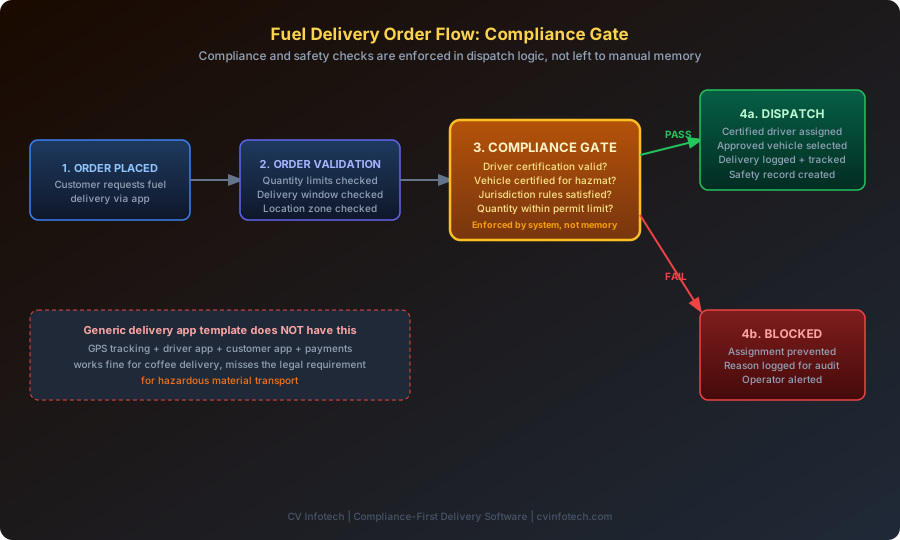
Search "fuel delivery app development" and you'll find dozens of nearly identical guides covering the same ground: GPS tracking, driver app, customer app, payment integration, admin dashboard, cost estimate. What almost none of them mention is the part that actually makes fuel delivery software different from a standard delivery app. Fuel is a regulated, hazardous material, and that changes the engineering requirements in ways a generic delivery-app template doesn't account for.
This post skips the feature-list-and-cost-estimate format entirely. That's covered plenty elsewhere. It focuses on what actually differentiates fuel delivery software: compliance logic, driver certification verification, and safety data most competitors' guides never touch.
Why Fuel Delivery Isn't Just Another Delivery App
The product being transported is hazardous
Unlike food or general goods delivery, fuel carries genuine safety and regulatory obligations. Transport licensing, vehicle certification, and quantity and handling regulations vary by jurisdiction. The US Federal Motor Carrier Safety Administration's hazardous materials regulations illustrate the scope of compliance requirements that apply before a fuel delivery vehicle leaves a depot. Software built for this needs to actively support compliance, not just move an order from point A to point B.
Driver certification isn't optional metadata
A generic delivery app treats a driver as an interchangeable resource. Fuel delivery requires verifying a driver holds the specific certifications and licenses required to transport hazardous materials in that jurisdiction, and that verification needs to be enforced in the dispatch logic itself, not just stored as a data field nobody checks.
Working on a fuel or hazardous-material delivery software project?
Written scope before billing. $30/hr. We tell you if we're not the right fit.
What Compliance Logic Actually Needs to Do
Preventing dispatch to uncertified drivers or vehicles
The dispatch system needs to actively block assigning a delivery to a driver or vehicle that isn't currently certified for hazardous material transport, rather than relying on a dispatcher to manually remember to check. A missed check here carries real legal and safety consequences, not just an inconvenienced customer.
Quantity and delivery-window regulations
Some jurisdictions restrict fuel delivery quantities or delivery windows near sensitive locations, schools, residential zones during certain hours. Building this into the system's order-validation logic, rather than as a policy someone has to remember, is what separates genuinely compliant software from a generic delivery template with a fuel-themed skin.
Incident and safety logging
A fuel delivery platform needs robust logging around delivery events: quantities delivered, timestamps, any reported incidents. This matters both for operational accountability and because this data may be required for regulatory reporting or in the event of an actual safety incident.
What a Generic Delivery-App Template Gets Wrong
Most "fuel delivery app" cost-and-feature guides describe the same generic stack: GPS tracking, driver app, customer app. None of that is wrong, exactly, but it's incomplete for a genuinely compliant fuel delivery operation. Treating it as sufficient is where real operational and legal risk hides.
The Reality of Building This Well
Compliance and safety logic isn't a feature you bolt onto a standard delivery app template afterward. It needs to be architected into the dispatch and order-validation logic from the start, since retrofitting hard compliance gates onto a system that wasn't built to enforce them is considerably harder than designing for it from day one.
Where We Fit
If your fuel delivery operation already has robust compliance and safety logic built into your software, this is confirmation you're ahead of most guides on this topic. Where we come in is for fuel or hazardous-material delivery businesses whose software still treats compliance as a manual process rather than an enforced system rule.
That's the same discipline behind our custom logistics and delivery software development and web application development practice, $30 an hour, written scope before any billing starts.

Akash Singh
View full profileCTO and Co-Founder, CV Infotech · Gurugram, India
Akash has been building Websites, Web Apps, SaaS and Mobile Apps for clients in the USA, Europe, Australia, and Canada since 2012. He leads a 100% in-house team and personally manages every client relationship and technical decision. Francisco Escobar has worked with him since 2012. Steven has trusted the team with his AI platforms since 2019. 512 verified 5.0 reviews on Freelancer.com.