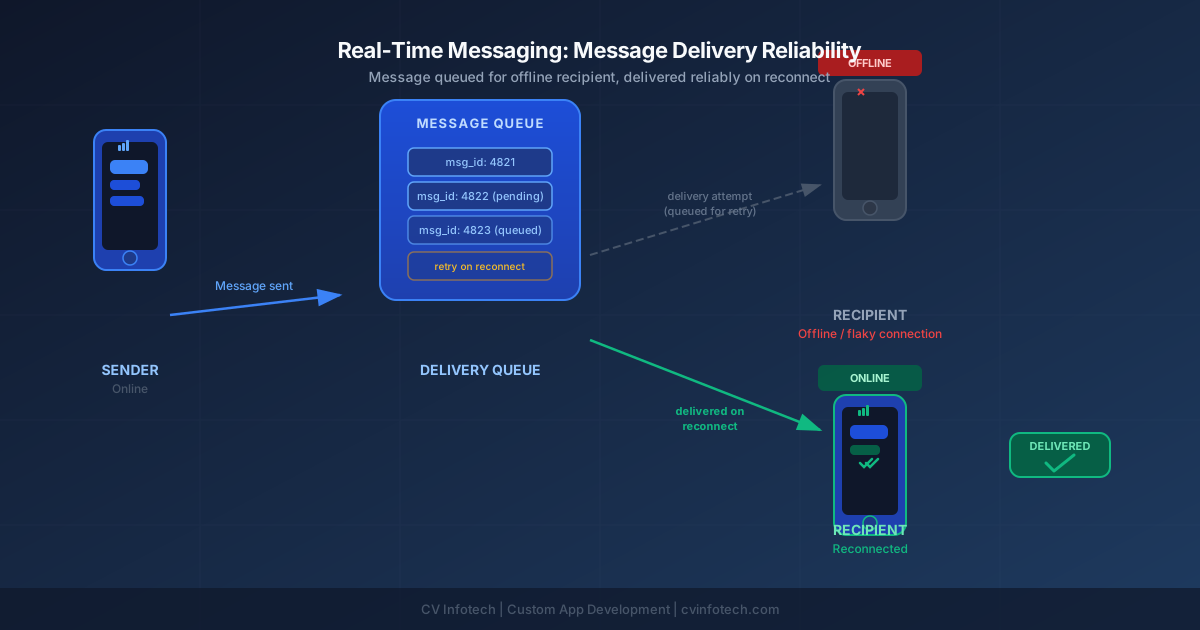
Most "how to build a messaging app" guides walk through the same surface-level steps: pick a framework, connect a chat UI, wire up a websocket, done. The actual hard engineering in a real-time messaging app has almost nothing to do with the chat bubbles on screen, and everything to do with what happens when a message needs to be delivered reliably to someone who might be offline, on a flaky connection, or switching between devices mid-conversation.
We've built real-time messaging into client platforms, and this post covers the specific engineering problems that separate a chat feature that works in a demo from one that holds up under real usage. Ably's engineering guide on real-time chat infrastructure covers this well from the infrastructure side. What follows focuses on the tradeoffs most teams only discover after launch.
The Core Problem: Messages Aren't Just "Sent"
What "delivered" actually needs to mean
A message is not meaningfully sent just because your server received it. It needs to actually reach the recipient, and the recipient might be offline, on a spotty connection, or have the app closed entirely. A genuinely reliable messaging system needs to queue undelivered messages and retry delivery, rather than assuming a websocket connection was open at the moment of sending.
Read receipts and delivery states, at scale
Distinguishing "sent," "delivered," and "read" sounds simple in a two-person demo. At real scale, tracking and updating that state across every conversation, especially group conversations where each participant has their own read state, becomes a genuine data and performance problem, not a UI toggle.
Offline Sync Is Harder Than It Looks
What happens when someone reopens the app after being offline
A user who was offline for an hour, or a day, needs to receive every message they missed, in the correct order, without duplicates, and without the app choking on a large sync payload. This requires deliberate message-history and sync-cursor design from the start, not something that can be bolted on after the real-time path is already built. Google's Android team outlines the architectural patterns behind offline-first app design that apply directly to messaging sync.
Multi-device sync adds another layer
If a user has the same account open on their phone and a browser tab, both need to reflect the same conversation state without one device showing stale data or duplicate messages. That means the sync logic has to account for multiple simultaneous read/write clients, not just one device per user.
Working on a real-time messaging development project?
Written scope before billing. $30/hr. We tell you if we're not the right fit.
Presence at Scale Is a Real Infrastructure Problem
Showing whether a contact is "online" seems trivial in a small app, but presence tracking at real scale, thousands of concurrent users, requires infrastructure specifically designed for high-frequency, low-latency state updates. A naive implementation that polls or broadcasts presence changes inefficiently can become a genuine performance bottleneck well before message volume itself does.
Encryption: The Tradeoff Nobody Wants to Make Explicit
End-to-end encryption changes what your backend can do
If messages are end-to-end encrypted, your server genuinely cannot read message content. That means features like server-side search, content moderation, or message previews in notifications need to be redesigned around that constraint, not assumed to work the way they would with unencrypted messages.
Most apps don't need full end-to-end encryption, and that's a real decision, not a shortcut
Not every messaging feature requires the same encryption guarantees as a security-focused product. Being explicit about what level of encryption a specific use case actually needs, rather than defaulting to either extreme, is a genuine architectural decision worth making deliberately rather than by default.
The Reality of Building This Well
None of these problems are exotic, but they require designing for reliability and scale from the start rather than treating them as edge cases to patch in later. Most teams building their first real-time messaging feature don't discover the offline-sync and presence-scaling problems until real users start hitting them.
Where We Fit
If you're building a simple, low-volume chat feature without demanding reliability or scale requirements, a straightforward implementation may be sufficient. Where we come in is for messaging features that need to handle real delivery guarantees, offline sync, and scale properly from the start, not discovered as problems after launch.
That's the same engineering discipline behind our web application development and custom software development work, $30 an hour, written scope before any billing starts.

Akash Singh
View full profileCTO and Co-Founder, CV Infotech · Gurugram, India
Akash has been building Websites, Web Apps, SaaS and Mobile Apps for clients in the USA, Europe, Australia, and Canada since 2012. He leads a 100% in-house team and personally manages every client relationship and technical decision. Francisco Escobar has worked with him since 2012. Steven has trusted the team with his AI platforms since 2019. 512 verified 5.0 reviews on Freelancer.com.