CV Infotech is a Shopify Verified Partner (ID: 2454630) with 512 verified 5.0 reviews on Freelancer.com. Our Shopify team has delivered store builds for clients in the USA, UK, and Australia since 2012. This guide is written from the inside, not from a review aggregator.
Most Shopify store owners I speak to have already hired a developer once. And most of them were disappointed.
Not because Shopify is difficult to build on. Because they hired based on the wrong signals: a polished portfolio PDF, a competitive quote, and a fast first response on Upwork. None of those things tell you whether a developer can actually build what you need, hold to a deadline, or hand you code you can maintain after they are gone.
Over 14 years of delivering eCommerce projects for clients in the US, UK, and Australia, I have watched businesses spend $8,000 to $25,000 on Shopify work that had to be completely rebuilt. The problem is almost never the technology. It is the gap between what a developer claims they can do and what they deliver under real conditions, with your actual product catalogue, your actual third-party integrations, and your actual launch date.
This is what I tell every client who comes to us after a bad experience.
What a "Shopify Developer" Actually Means
The title covers an enormous range of capability. A theme customiser is not the same as an app developer. A store setup specialist is not the same as someone who can write Liquid templates and connect your store to a warehouse management system via REST API. Before you post a job or start any conversation, you need to know which of these four things you are actually hiring for.
Theme customisation
Modifying an existing theme to match your brand: Liquid section edits, CSS adjustments, navigation changes. The most common type of Shopify work. A solid developer charges $25 to $45 per hour for this.
Custom theme development
Building from the ground up or from Shopify's Dawn framework. Requires deep Liquid knowledge, JavaScript proficiency, and an understanding of Shopify's section and block architecture. This is where performance work lives: Core Web Vitals, LCP optimisation, script loading strategy. Budget $40 to $70 per hour.
App development
Building a custom Shopify app using the Shopify CLI, the Admin API or Storefront API, and a backend in Node.js or Ruby. This is real software development, not theme work. Anyone who conflates the two is at the wrong skill level for your project.
Headless Shopify
Decoupling the Shopify backend from the frontend using the Storefront API and a framework like Next.js. High performance, complete design freedom, and significant complexity. Appropriate for stores doing meaningful annual revenue who have exhausted what a standard Shopify frontend can deliver.
The Technical Questions Worth Asking
These are not trick questions. They are the minimum bar for a developer claiming serious Shopify competence in 2026.
On Liquid and platform knowledge
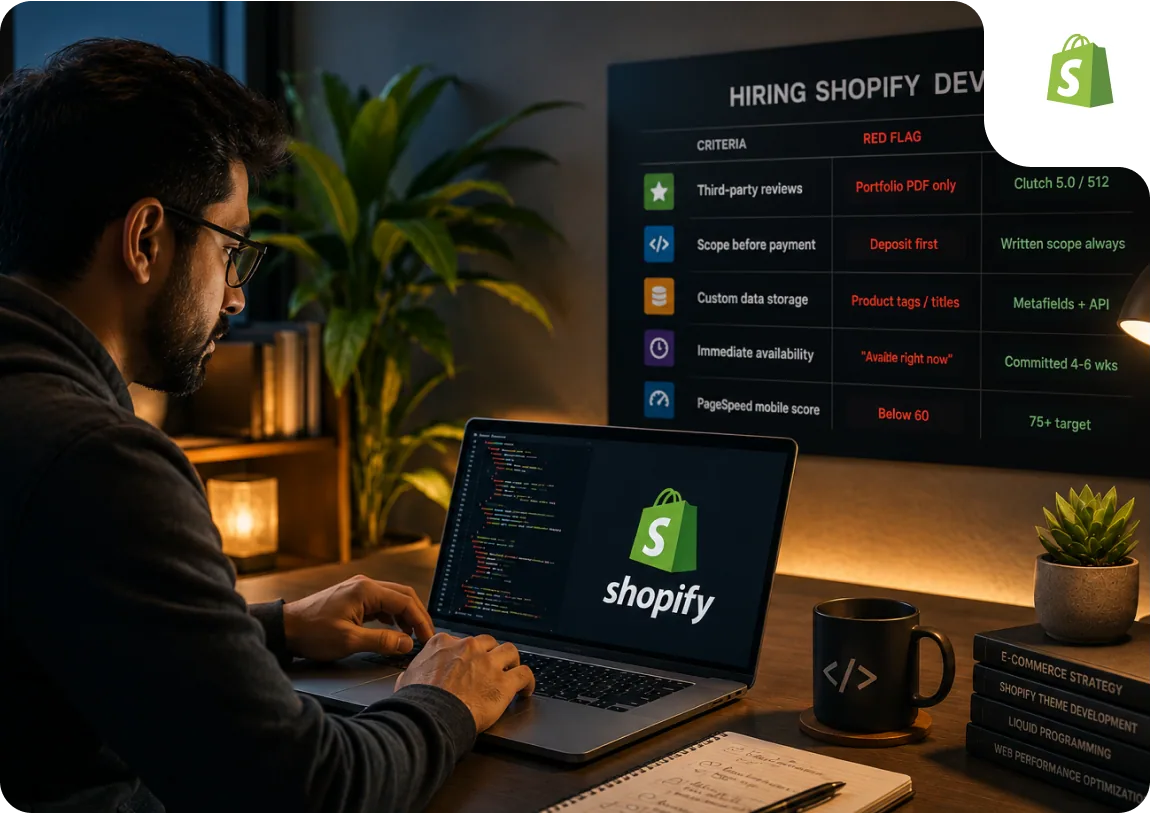
Ask any candidate to explain the difference between a standard for loop across collection products and using paginate for large catalogues. Ask how they approach Shopify metafields and metaobjects for custom data storage. If they are still putting custom data in product tags or variant titles, they have not kept up with the platform.
On JavaScript and the Shopify Ajax API
Dynamic cart updates, variant switching without page reload, bundle builders: these all run on JavaScript interacting with Shopify's Ajax API. Ask to see a vanilla JavaScript or Alpine.js implementation they have shipped. A developer who proposes introducing React for a straightforward cart interaction is either over-engineering or padding scope.
On performance
A Shopify theme scoring below 60 on Google PageSpeed Mobile is a conversion problem, not just a technical one. Ask what their typical Lighthouse score is on the themes they ship. Ask specifically what they do to reduce Largest Contentful Paint. Good answers mention lazy loading, deferred scripts, and image format decisions. Vague answers about writing clean code are not good answers.
On tooling
Any developer working in 2026 should be using Shopify CLI 3.x with live preview during development. If they are manually uploading theme files, they are slowing themselves down and will slow your project down too.
What Rates Actually Look Like
| Developer type | India (agency) | Eastern Europe | US or UK freelancer |
|---|---|---|---|
| Theme customisation | $25-40/hr | $35-55/hr | $70-110/hr |
| Custom theme | $30-50/hr | $45-70/hr | $90-160/hr |
| App development | $35-60/hr | $55-85/hr | $120-220/hr |
Rates reflect managed agency engagements with QA and project management included. Individual freelancer rates may be lower; the risk profile is different.
Red Flags I Would Walk Away From Immediately
No verified third-party reviews
A portfolio PDF proves nothing the developer did not choose to include. Clutch, Trustpilot, and Freelancer.com reviews from named clients are the only signals I take seriously. If a developer cannot point you to them, ask why not.
No written scope before payment
Any developer who asks for a deposit before producing a document listing every deliverable, every exclusion, and every revision round is asking you to trust them without accountability. I produce a written scope before any billing starts. Any serious developer does the same.
They build custom what Shopify already handles natively
If a developer proposes building a custom inventory management system when Stocky or TradeGecko already integrate, they are either unfamiliar with the ecosystem or creating lock-in to their own code. Both are problems you pay for later.
They cannot name what they will not do
Competent developers know their limits. Ask them to describe their approach to a headless Shopify build with Next.js App Router. The specificity of the answer tells you exactly what they actually know.
Why Hiring In-House Is Harder Than It Looks
A single in-house Shopify developer is a single point of failure. When they leave, and skilled developers always have options, you are left with undocumented customisations, a knowledge gap, and the cost of finding and ramping up a replacement. The work stops. The institutional knowledge goes with them.
The freelance market has a different problem: the developers worth hiring are almost always committed four to six weeks out. The ones with immediate availability are available for a reason. That reason is usually worth understanding before you sign anything.
A managed agency engagement changes both of these. The knowledge is documented because the process requires it. The work continues because the team does not depend on one person. The communication is consistent because account management is part of what you are paying for.
Working on a Shopify project?
Written scope before billing. $30/hr. We tell you if we're not the right fit.
How CV Infotech Approaches This
We are a Shopify Verified Partner with a 100% in-house development team and 512 verified 5.0 reviews on Freelancer.com. No subcontracting. No marketplace developers. The same team that scopes your project delivers it.
Our rate is $30 per hour. Scope document before any payment. Every deliverable listed, every exclusion named. Manny, who runs multiple eCommerce businesses in the US, has worked with us across several projects because the handover documentation means he owns what we build, not us.
If you are evaluating Shopify developers right now and want a written scope before committing to anything, start with our Shopify development agency page or reach us directly at letsbuild@cvinfotech.com. We will tell you in the first call if we are the right fit or not.

Akash Singh
View full profileCTO and Co-Founder, CV Infotech · Gurugram, India
Akash has been building Websites, Web Apps, SaaS and Mobile Apps for clients in the USA, Europe, Australia, and Canada since 2012. He leads a 100% in-house team and personally manages every client relationship and technical decision. Francisco Escobar has worked with him since 2012. Steven has trusted the team with his AI platforms since 2019. 512 verified 5.0 reviews on Freelancer.com.