What Is the Universal Commerce Protocol?
How UCP works in practice
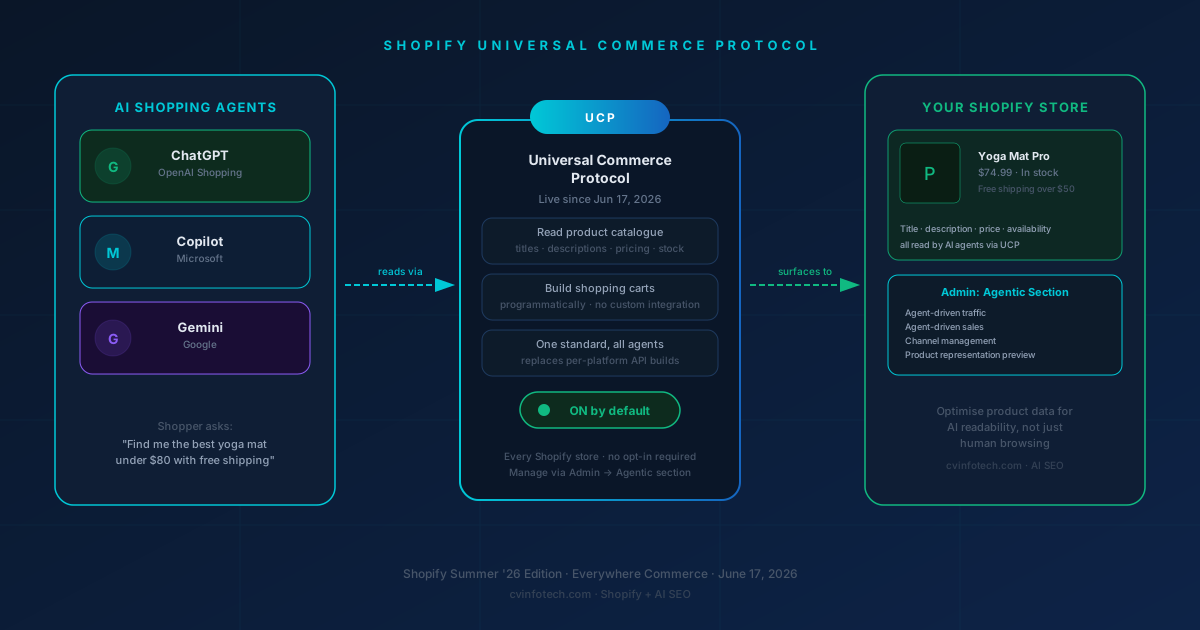
UCP is a standard that lets AI shopping agents read a store's product catalogue and construct a shopping cart programmatically, without a custom-built integration for each AI platform. Before UCP, if a store wanted its products discoverable inside an AI assistant, that typically meant a bespoke feed or API integration built specifically for that one platform. UCP replaces that with a single standard every AI agent can read.
Why Shopify enabled this by default
Shopify's framing across its own Summer '26 Editions communications is that commerce is increasingly happening wherever a customer already is, and in 2026 that means inside AI assistants as much as on a store's own homepage. Enabling UCP by default rather than as an opt-in reflects that shift. Shopify is betting that most merchants would want this discoverability rather than actively choosing it, which is why it shipped as the default rather than a toggle merchants had to find and switch on.
What's Actually in Your Admin Now
The new Agentic section
Every Shopify admin now has a dedicated Agentic section, a single place to see how your products surface to AI agents, manage which AI channels are active, and track agent-driven traffic and sales as a distinct category from regular organic or paid traffic.
What to check first
Open the Agentic section and look at how your top products are actually represented. Product titles, descriptions, and pricing all feed into what an AI agent sees and potentially repeats back to a shopper. If your product descriptions were written primarily for human browsing rather than for being parsed and summarised by an AI system, this is worth a look before assuming the default setup is serving your products well.
Working on a Shopify product data optimisation for AI discovery project?
Written scope before billing. $30/hr. We tell you if we're not the right fit.
Should You Change Anything, or Leave the Default?
The case for leaving it as-is
For most small and mid-size merchants, the default UCP setup is a reasonable starting point. It costs nothing to have enabled and doesn't require any immediate action to benefit from AI-driven discovery if and when it happens.
The case for actively optimising
If a meaningful share of your traffic could plausibly come through AI shopping assistants, higher-consideration purchases, comparison-heavy categories, anything where a shopper might reasonably ask an AI for a recommendation, it's worth treating your product data the way you'd treat SEO content: clear, accurate, well-structured descriptions that represent your products well when an AI agent reads and summarises them, not just when a person scrolls past them.
The Bigger Pattern: Shopify Absorbing the App and Discovery Layer
UCP isn't an isolated feature. It's part of the same Summer '26 shift that ended Shopify Scripts and introduced native AI merchandising and native A/B testing.
The common thread across all of these: functionality that used to require a third-party app or a custom integration is increasingly built into Shopify itself. That's worth factoring into any app-spend audit. If you're paying for a tool that does something AI discovery or merchandising related, it's worth checking whether Shopify's native version now covers the same ground.
The Reality of Handling This In-House
Most merchants and even most in-house marketing teams haven't had a reason to think about how product data reads to an AI system rather than a human. This is a genuinely new consideration, not an established discipline with years of best practices behind it yet. Figuring out whether your current product descriptions represent you well to an AI agent, and rewriting them if they don't, takes a different lens than typical ecommerce copywriting.
Where We Fit
If you've checked your Agentic section and you're comfortable with how your products are represented, you likely don't need to do anything further right now. The default setup is functioning as intended. Where we come in is for merchants who want their product data actively optimised for how AI agents read and represent it, tying that work into the same SEO and content strategy we already build for search visibility more broadly.
That's the same integrated approach behind our AI SEO work, $30 an hour, written scope before any billing starts. Also see our Shopify development service.

Akash Singh
View full profileCTO and Co-Founder, CV Infotech · Gurugram, India
Akash has been building Websites, Web Apps, SaaS and Mobile Apps for clients in the USA, Europe, Australia, and Canada since 2012. He leads a 100% in-house team and personally manages every client relationship and technical decision. Francisco Escobar has worked with him since 2012. Steven has trusted the team with his AI platforms since 2019. 512 verified 5.0 reviews on Freelancer.com.