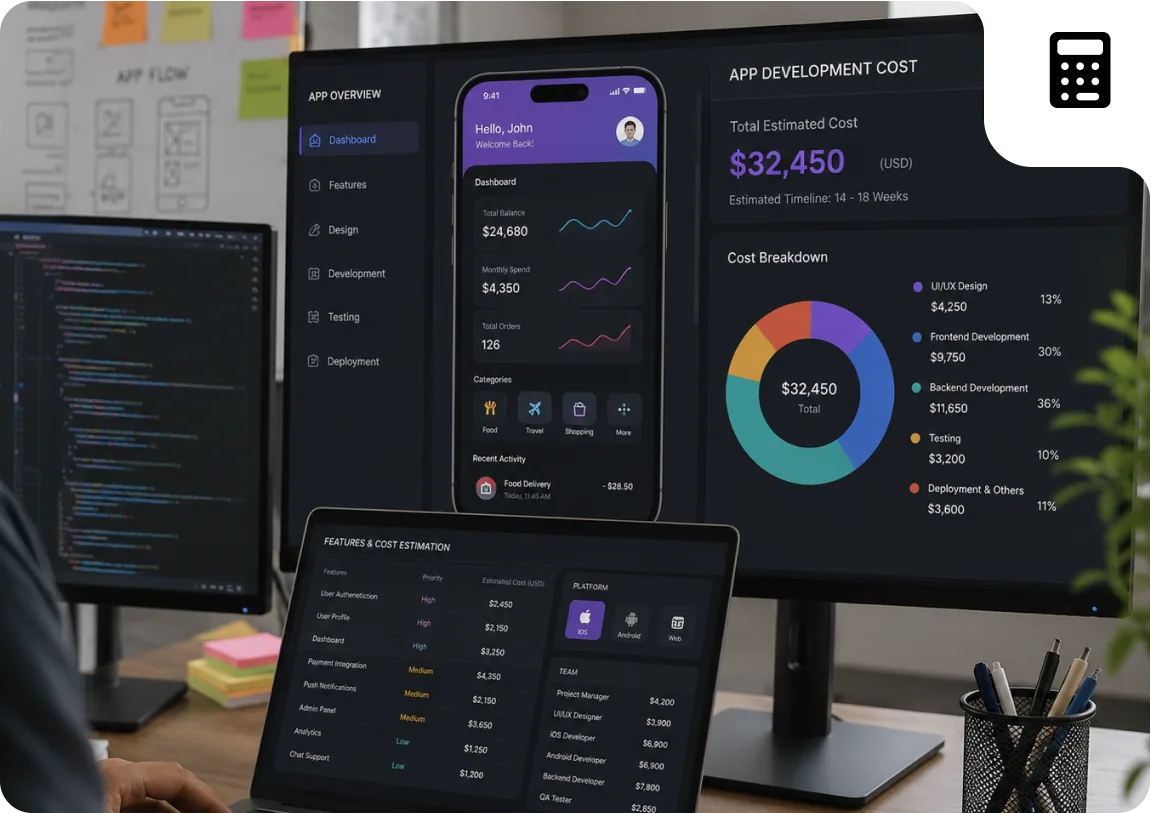
One of the first questions businesses ask when considering offshore web development is: what does it actually cost? The answer depends on your application's complexity, the technology stack, the team composition and the engagement model. This guide breaks down real pricing ranges for 2026, explains what drives the cost differences and gives you a framework for evaluating whether a quote is reasonable.
Web App Development Cost Ranges in India (2026)
Simple web application: $4,000–$12,000
Covers applications with 5–10 screens, basic user authentication, a standard database and a REST API backend. Examples: a company intranet, a simple booking system, a basic customer portal. Timeline: 8–14 weeks.
Mid-complexity web application: $12,000–$35,000
Applications with 15–30 screens, multiple user roles, complex business logic, third-party integrations and a custom admin dashboard. Examples: a SaaS product MVP, a booking platform, a project management tool. Timeline: 14–24 weeks.
Complex web application: $35,000–$100,000+
Applications with 30+ screens, real-time features, complex data models, high-availability infrastructure requirements and comprehensive QA. Examples: a marketplace platform, a fintech application, an enterprise management system. Timeline: 6–12+ months.
What These Prices Include
A transparent Indian web development agency's quote includes: requirements analysis and technical specification, UI/UX design (wireframes and high-fidelity screens), frontend and backend development, database design and implementation, third-party API integration, unit and integration testing, staging environment deployment, production launch and 30 days of post-launch support.
Cost Comparison: India vs USA vs UK
The cost difference between Indian and Western development is driven almost entirely by labour costs, not by quality differences in deliverable output.
A mid-complexity web application ($12,000–$35,000 in India) costs $60,000–$150,000 at a US agency of equivalent quality and $40,000–$100,000 at a UK agency. The same developers, following the same frameworks, producing the same quality of code, the only variable is what they earn.
For a business with a $30,000 development budget, this difference is the difference between building a mid-complexity application in India versus building a simple application in the USA.
What Drives Cost Variation in Indian Web Development
Technology stack. React and Node.js development is widely available in India and priced competitively. More specialist stacks command higher rates. eCommerce platforms like Magento have more specialised talent.
Team seniority. A junior developer costs $15–$22/hour. A mid-level developer costs $22–$35/hour. A senior developer costs $35–$50/hour. The right seniority mix depends on your project complexity.
Engagement model. Fixed-price project work is typically priced with a buffer for scope uncertainty. Dedicated developer hiring is billed at a monthly rate and is cheaper per hour, but transfers scope management responsibility to you.
Project management overhead. Agencies that provide a dedicated project manager add 10–20% to development costs. This is worth paying for complex, long-running projects.
What to Watch Out For in Low-Cost Quotes
Quotes significantly below the ranges above should raise questions, not excitement. Common causes of unrealistically low quotes: junior-only development teams, no QA budget, excluded items billed as change requests later, or template-based delivery rather than custom development.
The right question is not "who is cheapest?" but "who delivers the best value at a fair price?" A $15,000 mid-complexity application that works correctly and is delivered on time is better value than a $5,000 application that requires $20,000 of rework.
CV Infotech offers a free 30-minute consultation for businesses considering a web development project or custom web application build. We assess your requirements honestly and provide a fixed-price quote with no obligation. Get in touch to start that conversation.

Akash Singh
View full profileCTO and Co-Founder, CV Infotech · Gurugram, India
Akash has been building Websites, Web Apps, SaaS and Mobile Apps for clients in the USA, Europe, Australia, and Canada since 2012. He leads a 100% in-house team and personally manages every client relationship and technical decision. Francisco Escobar has worked with him since 2012. Steven has trusted the team with his AI platforms since 2019. 512 verified 5.0 reviews on Freelancer.com.
Continue Reading