CV Infotech quotes web application projects every week. John Gowland's real estate platform was an 8-month web application build: he said the service delivered exceeded his expectations. UltimaBot and UltimaWriter have been running in production since 2019. These prices come from actual project invoices, not survey data.
The most common question I get on a first discovery call is: how much should this cost?
Most people have already searched this. They found articles saying somewhere between $5,000 and $500,000 and walked away no more informed than before they searched. That range is not dishonest. It is accurate. But it is useless without knowing what drives it.
Every price in this article is based on CV Infotech's $30 per hour rate. I have included comparable figures for Eastern European agencies ($50 to $80/hr) and US agencies ($100 to $200/hr) where they are relevant. The cost difference is not a quality difference. It is a cost of living difference that allows Indian agencies to operate at a lower price point for the same technical output.
What a Web Application Actually Is
A web application is software that runs in a browser and does something more than display content. The distinction that matters for cost is this: a website presents information. A web application processes it. A web application authenticates users, stores data in a database, applies business logic to that data, and returns results that are unique to each user or session. A blog is a website. A project management tool is a web application. A marketing page is a website. A customer portal with invoices, documents, and role-based access is a web application.
The cost difference between a website and a web application is substantial because web applications require a backend: a server, a database, an authentication system, and an API layer that the frontend communicates with. Each of these adds architecture decisions, development time, testing overhead, and ongoing maintenance cost that a static website does not have.
Website (not a web application)
- Marketing and content pages
- Blogs and editorial sites
- Landing pages and brochure sites
- Static portfolio or documentation
Web application (requires backend)
- Client portals with user accounts
- SaaS dashboards and admin panels
- Booking and scheduling systems
- Inventory, CRM, and project tools
A web application that handles user authentication and a handful of database records is a fundamentally different build from a multi-tenant SaaS platform serving hundreds of client organisations with per-tenant data isolation, usage-based billing, and a Salesforce integration. They are both web applications. They are not the same scope, the same risk, or the same cost.
The Five Cost Factors
These five factors explain why two applications that sound similar on a one-sentence description can have costs that differ by a factor of five.
Integration count and complexity
Each third-party integration adds specification, authentication, data mapping, error handling, and testing work. A well-documented REST API with a maintained SDK (Stripe, Twilio, SendGrid) costs 10 to 20 hours to integrate. A legacy enterprise system with SOAP endpoints and limited documentation can cost 40 to 80 hours for the same data flow. Integration count is the most reliable predictor of mid-project cost growth.
Real-time features
A web application with real-time updates (live dashboards, collaborative editing, push notifications) requires WebSocket infrastructure in addition to the standard HTTP request cycle. This adds to both the backend and the frontend. Real-time features at scale also add to hosting cost. They are worth including when the business case is clear and worth deferring when it is not.
Multi-tenancy
Designing a database schema for multi-tenancy from the start is substantially cheaper than retrofitting it later. The data isolation approach — shared tables with a tenant ID, separate schemas, or separate databases — must be decided before the first migration is written. Changing this decision after launch is effectively a rewrite.
Authentication complexity
Username and password with email verification is straightforward. Single sign-on with SAML 2.0 for enterprise clients is a separate implementation effort. OAuth social login with multiple providers adds configuration overhead. Multi-factor authentication with backup codes adds more. Authentication scope is often underspecified in initial requirements and expanded during development.
Compliance and audit requirements
HIPAA-compliant data handling, SOC 2 audit logging, GDPR right-to-erasure implementation, and PCI DSS for payment card data all require specific architectural decisions that affect cost throughout the build. If your application handles health data, financial data, or EU personal data, compliance scope should be established at the requirements stage, not added later.
Real Budget Ranges by Project Type
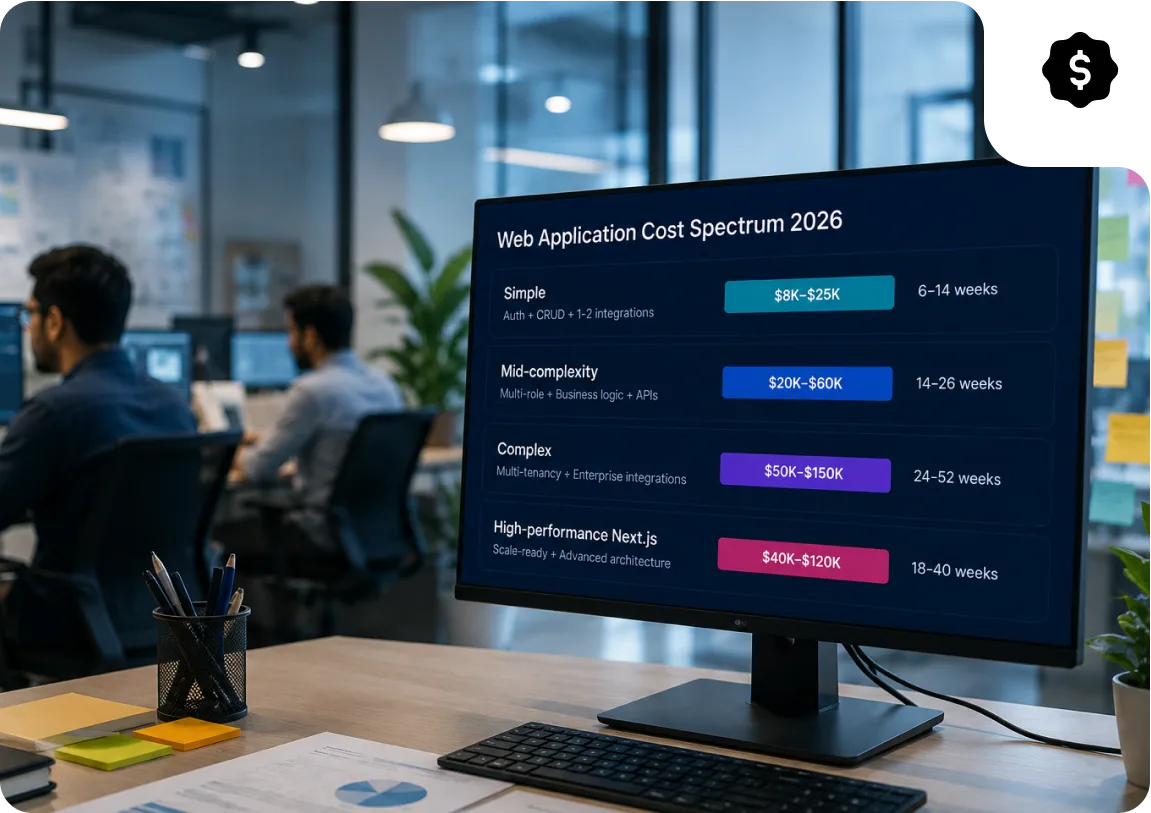
Simple web application
Auth + CRUD + 1 to 2 integrations · 5 to 10 screens
$8,000 to $25,000
6 to 14 weeks
Basic authentication (email and password), CRUD operations on a primary data model, one or two third-party integrations (payment gateway, email, or CRM), and a straightforward user interface with 5 to 10 screens. Examples: a client portal for a service business, a simple booking system, a basic inventory manager, a project tracking tool with a small team scope.
Mid-complexity application
Multi-role · Business logic · 5 to 10 integrations
$20,000 to $60,000
14 to 26 weeks
Multiple user roles with different permissions and views, complex business logic with conditional workflows, 5 to 10 third-party integrations, reporting or analytics features, and a more complex UI with data visualisation, filtered tables, and real-time updates. Examples: a field service management tool, a multi-tenant SaaS MVP, a complex booking platform with scheduling logic.
Complex application
Multi-tenancy · Enterprise integrations · Compliance
$50,000 to $150,000
24 to 52 weeks
Full multi-tenancy with per-tenant data isolation, enterprise system integrations (ERP, HRMS, legacy databases), compliance requirements (HIPAA, SOC 2, GDPR right-to-erasure), usage-based billing with metered features, and complex real-time collaboration or notification systems.
High-performance Next.js build
Custom API · CDN · Edge rendering
$40,000 to $120,000
18 to 40 weeks
A performance-critical application built with Next.js App Router, a custom Express or Fastify API layer, CDN configuration, and edge rendering for sub-100ms response times globally. Typically includes a component library, TypeScript throughout, automated testing, and CI/CD infrastructure. Performance against{" "}Google Core Web Vitals{" "}is built into the architecture, not bolted on after launch.
| Team rate | Hours available at $30K | What you can build |
|---|---|---|
| $30/hr (India, CV Infotech) | 1,000 hours | Full mid-complexity app or solid complex MVP |
| $60/hr (Eastern Europe) | 500 hours | Simple app or well-scoped mid-complexity MVP |
| $150/hr (US / UK agency) | 200 hours | Prototype or a small simple application |
The Hidden Costs Most Quotes Miss
A web application is not a finished product at launch. It is the beginning of an operational relationship with the codebase. These costs are routinely absent from initial quotes and routinely present on the final annual total.
Infrastructure and hosting
A simple application on a managed PaaS (Railway, Render, Fly.io) costs $20 to $80/month. A production application requiring auto-scaling, a separate database host, Redis, and a CDN costs $200 to $800/month depending on traffic. High-traffic SaaS applications on AWS or GCP with load balancers, managed PostgreSQL, and multi-region deployments cost $500 to $3,000/month. Infrastructure is a product of architecture decisions made during the build.
Dependency and security updates
Node.js packages, Python libraries, and database drivers release security patches continuously. An unmaintained application accumulates vulnerabilities. Dependency updates require testing on every change. Budget 4 to 8 hours per month for active maintenance on a simple application, 8 to 20 hours for mid-complexity, and 20 to 40 hours for complex applications.
Performance monitoring and observability
Application performance monitoring (Datadog, New Relic, Sentry) costs $20 to $200/month for a production application. Without it, you are operating blind: you do not know where the application is slow, which endpoints are failing, or what error rates look like in production. This is not optional for any production application with real users.
Scope additions during build
The most consistent hidden cost in every web application project is scope that was not defined in the initial quote. A development contract without a written deliverables list is an invitation for scope disagreements. Additions that appear small (a second user role, a new report format, a CSV export) each require development, testing, and QA that was not in the original estimate.
Why Building In-House Is More Expensive Than It Looks
Many product teams consider building their web application with in-house developers. The reasoning is sound in principle: full ownership, no agency overhead, institutional knowledge. The cost reality is consistently higher than the initial estimate.
| Cost element | US / UK | CV Infotech ($30/hr) |
|---|---|---|
| Senior full-stack developer | $120K to $180K/yr salary | $30/hr, billed by hours delivered |
| Recruitment cost | $15K to $30K per hire | $0 |
| Benefits and overhead | +30 to 40% of salary | $0 |
| Ramp-up time | 4 to 8 weeks unproductive | Day 1 productive |
| Full-stack + design + QA | 3 hires minimum | One team, one contract |
A single senior full-stack developer in the US costs $150,000 to $220,000 per year fully loaded. For a 6-month project, that is $75,000 to $110,000 in developer cost alone, before benefits, management overhead, tooling, or the cost of QA and design. A CV Infotech mid-complexity application for the same scope costs $20,000 to $60,000, total, with QA, design, and written scope included.
In-house makes sense for long-running product businesses with stable teams and ongoing development needs. For a defined-scope web application build, outsourcing to an agency with written scope delivers significantly better cost outcomes.
Working on a web application project?
Written scope before billing. $30/hr. We tell you if we're not the right fit.
How CV Infotech Approaches This
We scope web applications in detail before quoting. Every project starts with a requirements call where we establish: the user roles and their workflows, the integrations required, the data model at a high level, the performance requirements, and any compliance constraints. We produce a written scope document with a deliverables list and a fixed price before any development begins.
- Written scope and fixed price before work starts. No surprises mid-project.
- Sprint-based delivery with a working build on your device at the end of every two weeks.
- Direct access to the lead developer throughout the project. No account manager intermediaries.
- $30/hr. We quote the number of hours for the scope, not a blended rate that obscures the actual effort.
- 30-day post-launch support included. Bugs found after launch are fixed at no additional charge within the support window.

Akash Singh
View full profileCTO and Co-Founder, CV Infotech · Gurugram, India
Akash has been building Websites, Web Apps, SaaS and Mobile Apps for clients in the USA, Europe, Australia, and Canada since 2012. He leads a 100% in-house team and personally manages every client relationship and technical decision. Francisco Escobar has worked with him since 2012. Steven has trusted the team with his AI platforms since 2019. 512 verified 5.0 reviews on Freelancer.com.