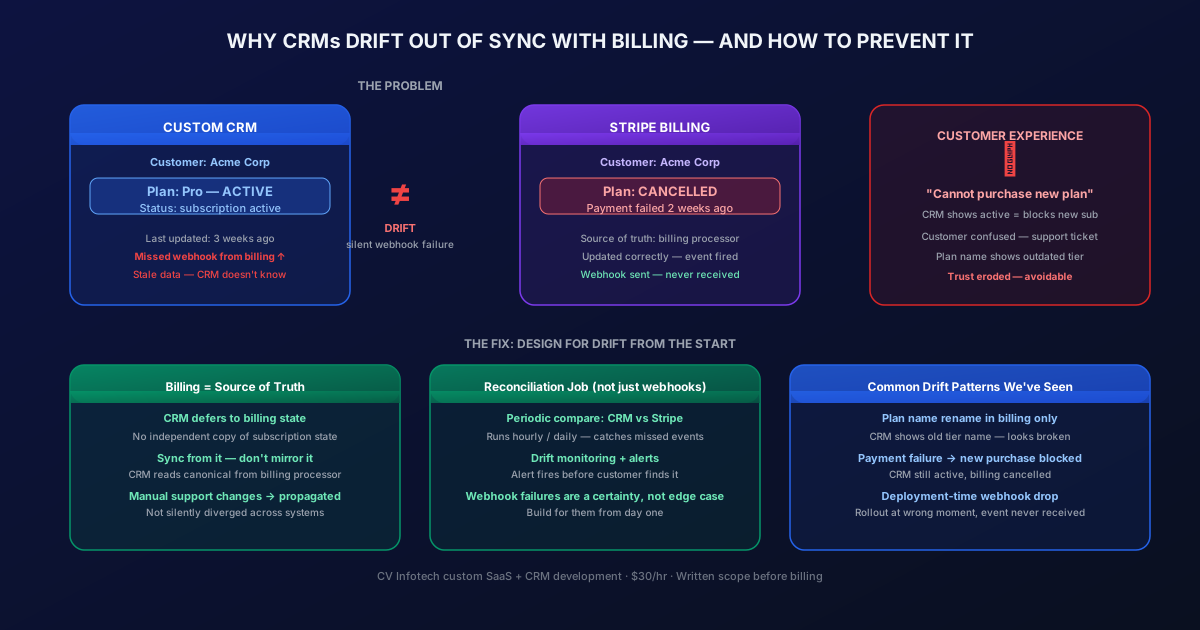
Most articles about custom CRM development focus on features: pipelines, dashboards, reporting. The part that actually causes real production incidents is quieter and less talked about: keeping a CRM in sync with whatever system handles billing, usually Stripe, once the two are supposed to represent the same customer's subscription state.
The Core Problem: Two Systems, One Truth
Why this is harder than it sounds
A CRM and a billing processor both need to know a customer's current plan, payment status, and subscription state, but they are separate systems, updated through separate events, on separate timelines. The moment either system misses an update, a webhook that fails silently, a manual change made in one place but not the other, they stop agreeing, and nothing necessarily alerts anyone until a customer hits the mismatch directly.
Manual updates are where drift usually starts
A support agent manually adjusting a customer's subscription in the billing dashboard, without that change reflecting back into the CRM automatically, is one of the most common ways these two systems quietly diverge. It works fine in the moment and creates a ticking inconsistency that surfaces later, often when the same customer tries to make a new purchase.
Real Patterns That Cause This, and What They Look Like
Subscription plan names getting out of sync
If a billing processor's product or plan names change, and the CRM does not get updated at the same time, customers can lose visibility into what plan they are actually on, seeing an outdated or mismatched plan name in their account, which looks broken even though the underlying billing is technically fine.
Payment failures blocking new purchases
A common, confusing failure: a customer's previous payment failed, the billing system correctly marked that subscription as cancelled, but the CRM never got the update, so it still shows an active conflicting state that blocks the customer from purchasing a new subscription entirely, even though nothing about their account should be stopping them.
Silent webhook failures
Most CRM-to-billing sync relies on webhooks. If a webhook silently fails, due to a timeout, a deployment happening at the wrong moment, an unhandled edge case, the CRM simply never learns that something changed, and there is often no obvious alert unless you have specifically built monitoring for it. Stripe's webhook best practices documentation covers why real-time webhook delivery alone is never fully reliable.
Working on a custom CRM and SaaS development project?
Written scope before billing. $30/hr. We tell you if we're not the right fit.
How to Design This So It Does Not Quietly Break
Treat the billing processor as the source of truth
Rather than letting the CRM and billing system maintain independent copies of subscription state that can drift, design the CRM to defer to the billing processor's state on anything billing-related, syncing from it rather than maintaining a parallel version of the truth.
Build reconciliation, not just real-time sync
Real-time webhook sync will eventually miss an event, that is a certainty, not an edge case. A periodic reconciliation job that compares CRM records against the billing processor's actual state and flags mismatches catches what real-time sync alone will eventually let through. ScienceSoft's custom CRM development guide covers the broader architecture considerations for custom CRM systems.
Alert on drift, do not wait for a customer to find it
The difference between a minor sync gap and a real incident is usually how fast it is caught. Monitoring specifically for CRM-billing mismatches, rather than relying on a customer complaint to surface the problem, is what turns this from a recurring fire drill into a manageable, boring maintenance task.
The Reality of Building This Well
None of this is exotic engineering, but it requires deliberately designing for drift from the start rather than assuming a webhook integration is sufficient on its own. Most teams building their first CRM-billing integration do not build reconciliation or drift monitoring until after they have already had an incident that taught them it was necessary.
Where We Fit
If your CRM and billing system are already staying reliably in sync, you do not need this. Where we come in is designing or auditing exactly this integration, building the reconciliation and monitoring layer that catches drift before a customer does, based on patterns we have genuinely seen cause real production issues. That is the same discipline behind our custom SaaS and CRM development work, $30 an hour, written scope before any billing starts.

Akash Singh
View full profileCTO and Co-Founder, CV Infotech · Gurugram, India
Akash has been building Websites, Web Apps, SaaS and Mobile Apps for clients in the USA, Europe, Australia, and Canada since 2012. He leads a 100% in-house team and personally manages every client relationship and technical decision. Francisco Escobar has worked with him since 2012. Steven has trusted the team with his AI platforms since 2019. 512 verified 5.0 reviews on Freelancer.com.