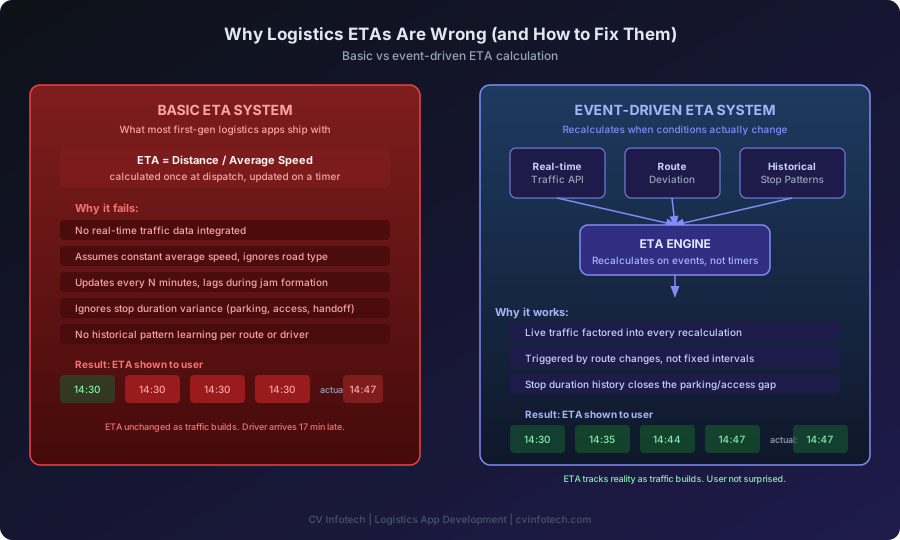
Almost every logistics app promises real-time ETA tracking, and almost every user of one of these apps has experienced an ETA that was confidently wrong. This isn't usually a bug in the traditional sense. It's a predictable consequence of how most ETA systems are built: a static calculation based on distance and average speed, recalculated too infrequently to reflect what's actually happening on the road right now.
This post skips the generic "logistics app development company" feature list. That's covered plenty elsewhere. It focuses on the specific technical problem that makes ETAs unreliable, and what an ETA system actually needs to do to be trustworthy.
Why Most ETA Calculations Are Wrong From the Start
Static distance-and-speed math doesn't reflect reality
A naive ETA calculation takes the remaining distance and divides it by an assumed average speed. This ignores current traffic conditions, road type, time of day, and anything that's actually happening on that specific route right now, producing a number that's often wrong the moment it's calculated, not just wrong later.
Infrequent recalculation compounds the problem
Even a reasonably good initial ETA becomes stale if it isn't recalculated frequently as conditions change. A traffic jam forms, a driver takes a different route, a delivery stop takes longer than expected. An ETA that only updates every several minutes will visibly lag reality during exactly the moments users check it most.
Working on a logistics app project?
Written scope before billing. $30/hr. We tell you if we're not the right fit.
What an Actually Reliable ETA System Requires
Real-time traffic data integration
A trustworthy ETA needs live traffic data factored into the calculation, not just distance and a generic average speed. Google Maps Platform's Routes API provides real-time traffic and route conditions that can be weighted into the calculation, and similar capabilities are available from HERE's Routing API . Using one of these rather than a static speed assumption is the single biggest lever on ETA accuracy.
Frequent, event-driven recalculation
Rather than recalculating on a fixed timer, a good system recalculates when meaningful events happen: the driver deviates from the expected route, a stop takes longer than the historical average, traffic conditions on the remaining route change significantly. This keeps the estimate current rather than stale between fixed intervals.
Learning from historical delivery patterns
Genuinely accurate ETA systems incorporate historical data about how long specific stops, routes, or drivers actually take, rather than relying purely on generic speed assumptions. Real-world delivery time includes parking, building access, and handoff time that a pure distance calculation never accounts for.
The Honest Tradeoff: Accuracy vs Complexity
Building a genuinely accurate ETA system is meaningfully more engineering work than the simple distance-and-speed calculation most basic logistics apps ship with. Real-time traffic integration, event-driven recalculation, and historical pattern learning all add real complexity and cost. Worth being honest about rather than promising perfect accuracy from a simple system.
The Reality of Building This Well
Most first-generation logistics apps ship with the simple calculation because it's fast to build, and the ETA-accuracy problem only becomes visible once real users start noticing the gap between promised and actual delivery times. Building it properly from the start avoids that credibility problem later.
Where We Fit
If your current ETA system is accurate enough for your users' expectations, this isn't an urgent problem worth solving. Where we come in is for logistics platforms where ETA accuracy has become a genuine customer trust issue, building the real-time data integration and recalculation logic that actually closes that gap.
That's the same discipline behind our custom logistics software development and web application development practice, $30 an hour, written scope before any billing starts.

Akash Singh
View full profileCTO and Co-Founder, CV Infotech · Gurugram, India
Akash has been building Websites, Web Apps, SaaS and Mobile Apps for clients in the USA, Europe, Australia, and Canada since 2012. He leads a 100% in-house team and personally manages every client relationship and technical decision. Francisco Escobar has worked with him since 2012. Steven has trusted the team with his AI platforms since 2019. 512 verified 5.0 reviews on Freelancer.com.