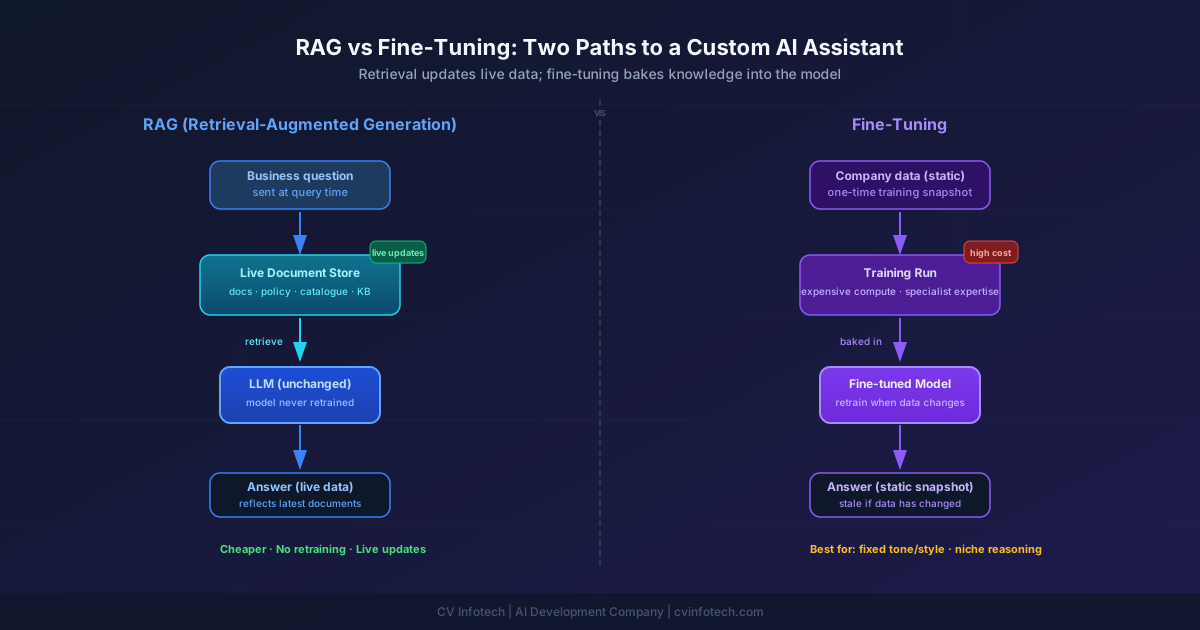
If you're evaluating building a custom AI assistant for your business, one that answers questions using your actual company data, support docs, product catalogue, internal knowledge base, you'll run into two competing approaches almost immediately: retrieval-augmented generation (RAG) and fine-tuning. Nearly every technical tutorial online explains how to build a RAG system yourself, and almost none of them address the actual business question: which approach fits your situation, and is building this yourself even the right call.
This post skips the code tutorial, plenty of those already exist, and covers the decision that actually matters: what RAG and fine-tuning each solve, which one fits most business use cases, and what building this properly actually requires beyond following a tutorial.
The Core Difference
RAG retrieves, it doesn't retrain
A retrieval-augmented system keeps your company's actual documents and data in a searchable store, and pulls relevant pieces of that data into the AI model's context at the moment someone asks a question. The underlying model itself never changes, you're feeding it your specific information on demand. IBM's comparison of RAG and fine-tuning covers this distinction clearly for business audiences.
Fine-tuning changes the model itself
Fine-tuning trains a version of the model on your specific data, baking that knowledge into the model's own weights. This is a fundamentally different, heavier process, and it needs to be redone every time your underlying data changes meaningfully.
Why RAG Wins for Most Business Use Cases
Your data changes, and RAG doesn't need retraining when it does
Product catalogues update, support documentation gets revised, policies change. A RAG system reflects those changes the moment the underlying documents are updated, since it's retrieving live data rather than baked-in training. Fine-tuning would require an entirely new training run every time something meaningful changes. AWS explains how retrieval-augmented generation works and why this live-retrieval property is central to its value.
RAG is dramatically cheaper to stand up and maintain
Fine-tuning requires meaningful compute and specialised expertise to do well, and doing it poorly can actually degrade a model's general capability. RAG's cost is mostly in the retrieval infrastructure and API calls, considerably more accessible for most business budgets.
Working on a AI development project?
Written scope before billing. $30/hr. We tell you if we're not the right fit.
Where Fine-Tuning Still Makes Sense
Fine-tuning earns its cost when you need the model to consistently adopt a very specific tone, format, or specialised reasoning pattern that simple retrieval can't achieve, situations that are genuinely less common for a typical business knowledge-assistant use case than the tutorials might suggest.
What Building This Properly Actually Requires
The retrieval quality matters more than the model choice
A RAG system is only as good as what it retrieves. Poor document chunking, weak embedding choices, or an unmaintained vector store produce a system that confidently retrieves the wrong information, which is arguably worse than an assistant that admits it doesn't know something.
This isn't a one-time build, it's ongoing maintenance
As your documents change, the retrieval index needs updating. As usage patterns reveal gaps, retrieval logic needs tuning. Most tutorials cover the initial build and stop there, the ongoing maintenance is where the real, less glamorous engineering work actually lives.
What CV Infotech Actually Builds
We route between OpenAI, Anthropic, and Gemini models depending on the specific task across our AI platforms, the same approach behind UltimaBot and UltimaWriter, choosing the right model and retrieval approach for what a given task actually needs rather than defaulting to one pattern everywhere.
The Reality of Building This In-House
Following a RAG tutorial to get a working demo is genuinely achievable for a technical team in an afternoon. Building retrieval quality, document maintenance workflows, and a system that degrades gracefully rather than confidently hallucinating, that's where most first attempts fall short, and it's a different skill set from following a tutorial.
Where We Fit
If you're comfortable building and maintaining your own RAG pipeline, the technical resources to do that well are genuinely out there. Where we come in is for businesses that want this built properly from the start, retrieval quality, ongoing document maintenance, and the right model routing for the task, not just a working demo.
That's the same discipline behind our AI development practice and AI SEO work, $30 an hour, written scope before any billing starts.

Akash Singh
View full profileCTO and Co-Founder, CV Infotech · Gurugram, India
Akash has been building Websites, Web Apps, SaaS and Mobile Apps for clients in the USA, Europe, Australia, and Canada since 2012. He leads a 100% in-house team and personally manages every client relationship and technical decision. Francisco Escobar has worked with him since 2012. Steven has trusted the team with his AI platforms since 2019. 512 verified 5.0 reviews on Freelancer.com.