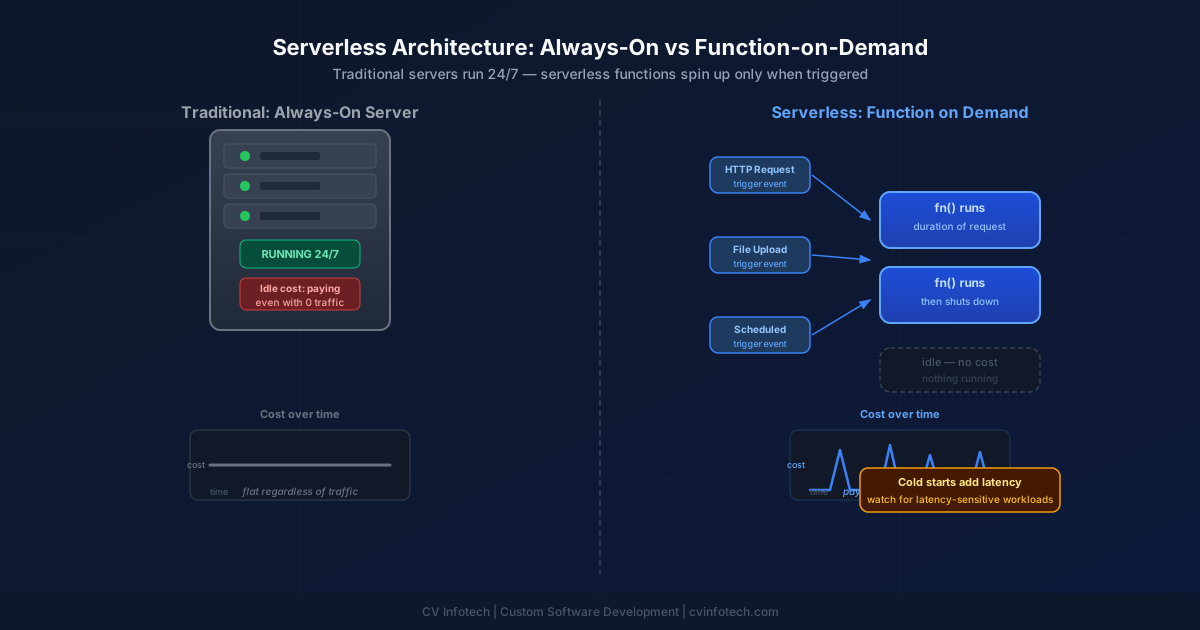
Serverless architecture, building an application from small, independent functions that run on demand rather than on servers you provision and manage yourself, has quietly become one of the default patterns in modern application development. The pitch is genuinely appealing: no server management, automatic scaling, and you only pay for actual usage rather than a server sitting idle.
The part that gets less airtime is when serverless is the wrong call, since the same properties that make it appealing for the right workload create real problems for the wrong one. This post covers both sides honestly, not just the pitch.
What Serverless Actually Means
Functions, not servers
Instead of running a persistent server process, a serverless application splits logic into small, independent functions, each triggered by a specific event, an HTTP request, a file upload, a scheduled time, and each running only for the duration of that specific task before shutting down.
The provider manages everything underneath
AWS Lambda, Google Cloud Functions, and Azure Functions all handle the actual server provisioning, scaling, and infrastructure management. You write and deploy function code; the platform handles the rest.
Where Serverless Genuinely Wins
Unpredictable or spiky traffic
A workload that sits mostly idle with occasional traffic spikes, a webhook handler, a scheduled report generator, an image-processing pipeline triggered by uploads, is close to ideal for serverless, since you're not paying for idle server capacity between spikes.
Reduced operational overhead
Not having to patch, scale, or monitor server infrastructure directly frees up real engineering time for teams without dedicated DevOps capacity, a genuine advantage for smaller teams especially.
Working on a custom software architecture project?
Written scope before billing. $30/hr. We tell you if we're not the right fit.
Where Serverless Genuinely Struggles
Cold starts hurt latency-sensitive workloads
A function that hasn't run recently needs to "cold start," initializing before it can process a request, adding latency that's a real problem for applications where consistent, fast response time matters. AWS documents this directly in their Lambda runtime environment documentation , a real-time API a mobile app depends on is a clear example.
Long-running processes don't fit the model
Serverless functions typically have execution time limits. Workloads involving long-running computation or persistent connections, some real-time features, certain data processing jobs, don't fit the short-lived function model without real architectural rework.
Costs can surprise you at high, sustained volume
The "pay only for usage" pitch works in your favour at low-to-moderate, spiky volume. At high, sustained, predictable volume, a traditional always-on server can end up cheaper than paying per-invocation at scale. Google Cloud's engineering team covers serverless cost modeling in practice , worth modeling both ways rather than assuming serverless is always cheaper.
The Real Decision Factor
If your workload is genuinely spiky or unpredictable and you don't have dedicated DevOps capacity, serverless is likely the right default. If your workload is latency-sensitive, involves long-running processes, or runs at high, sustained, predictable volume, a traditional server or container-based approach is worth seriously evaluating against the serverless pitch rather than assuming the trend applies to your case.
The Reality of Building This Well
Choosing serverless isn't the hard part. The actual engineering discipline is in architecting around its real constraints, cold starts, execution limits, and cost modeling at your actual expected scale, rather than adopting it purely because it's the current trend.
Where We Fit
If you're confident serverless fits your specific workload and you're comfortable with the tradeoffs, that's a reasonable path to build on your own. Where we come in is for businesses that want an honest assessment of whether serverless actually fits their specific traffic pattern and latency needs, rather than defaulting to it because it's trending.
That's the same discipline behind our custom software development practice and web application development, $30 an hour, written scope before any billing starts.

Akash Singh
View full profileCTO and Co-Founder, CV Infotech · Gurugram, India
Akash has been building Websites, Web Apps, SaaS and Mobile Apps for clients in the USA, Europe, Australia, and Canada since 2012. He leads a 100% in-house team and personally manages every client relationship and technical decision. Francisco Escobar has worked with him since 2012. Steven has trusted the team with his AI platforms since 2019. 512 verified 5.0 reviews on Freelancer.com.