What Actually Makes Something SaaS?
The core definition
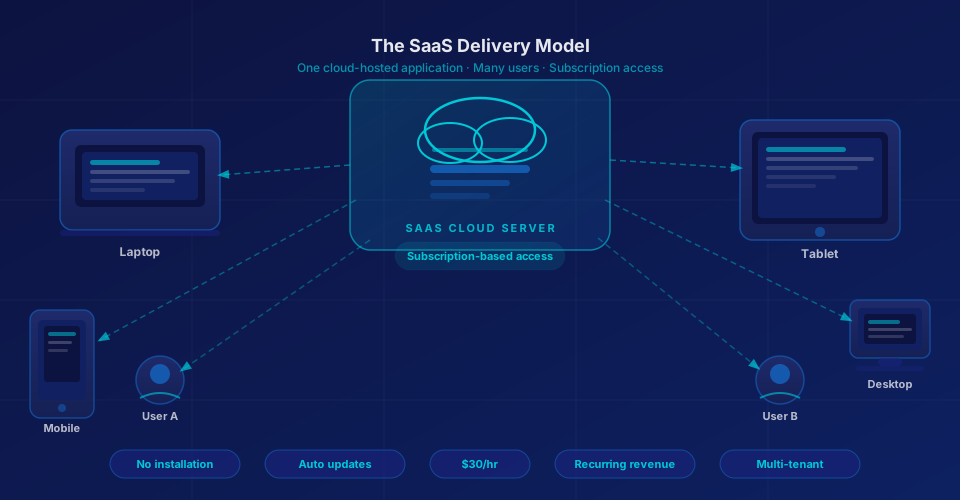
Software as a service means the software runs on the provider's servers, not your own device, and you access it through a browser or a thin client app, typically paying a recurring subscription rather than a one-time purchase. The provider handles hosting, maintenance, security patches, and updates, you just use the product.
SaaS versus other software delivery models
SaaS sits alongside two related models: PaaS (platform as a service), which gives developers a platform to build their own applications on, and IaaS (infrastructure as a service), which provides raw computing infrastructure like servers and storage. SaaS is the layer closest to the end user, a finished product you use directly, rather than infrastructure or a development platform.
| Model | What it delivers | Who manages it | Examples |
|---|---|---|---|
| SaaS | Finished application | Provider | Gmail, Slack, Netflix |
| PaaS | Development platform | Developer builds on it | Heroku, Google App Engine |
| IaaS | Raw infrastructure | Business manages itself | AWS EC2, Azure VMs |
Real SaaS Examples Across Categories
Productivity and collaboration
Google Workspace, Slack, and Notion are all SaaS, you access them through a browser or app, pay a subscription per user, and the provider handles everything running behind the scenes.
Customer relationship management
Salesforce and HubSpot are SaaS platforms built specifically for managing customer relationships and sales pipelines, accessed entirely through the browser with no local installation required beyond the browser itself. TechTarget's breakdown of SaaS applications covers the full range of business categories in more detail.
Entertainment and media
Netflix and Spotify are consumer SaaS, you're not buying individual movies or songs, you're paying a subscription for ongoing access to a hosted library, the defining trait of the model.
Is ChatGPT a SaaS product?
Yes, ChatGPT fits the SaaS definition, it's accessed through a browser or app, runs on OpenAI's servers, and is available through a subscription tier for expanded access, the same delivery pattern as any other SaaS product, even though the underlying technology is quite different from a typical business tool.
Why SaaS Became the Dominant Software Model
SaaS removed the friction that used to come with buying software: no installation, no manual updates, no worrying about whether your computer meets the system requirements. For the provider, it also changed the business model, from a one-time sale to recurring revenue, which funds continuous improvement rather than a single release followed by years of the same static product.
What Building a SaaS Product Actually Involves
The technical foundation
A SaaS product needs multi-tenant architecture, meaning the same application instance serves many different customers securely without their data mixing, reliable hosting infrastructure that scales as your user base grows, and a billing system that handles subscriptions, upgrades, downgrades, and failed payments cleanly.
Where most first-time SaaS builders underestimate the work
The core product feature is often the easiest part. Authentication, permission systems, billing integration, and the infrastructure to handle real user load reliably are where most of the actual engineering time goes, and they're rarely the part a founder pictures when they first imagine the product.
The layers most first-time builders underestimate:
- Multi-tenant architecture: keeping each customer's data isolated within a shared application
- Authentication and permission systems: role-based access, SSO, session management
- Billing infrastructure: subscriptions, proration, upgrades, failed payment recovery
- Scalable hosting: handling traffic spikes without performance degradation
The Reality of Building This In-House
Building a SaaS product from scratch requires expertise across several distinct areas, backend architecture, billing systems, security, and frontend development, that rarely live in one person. Most successful SaaS products we've seen built well involved either a technical co-founder with genuinely broad experience or a team that divided these concerns clearly from the start.
What CV Infotech Actually Builds
UltimaBot and UltimaWriter, the AI platforms we've built and maintained for our client Steven since 2019, are both SaaS products in the fullest sense, multi-tenant, subscription-based, continuously updated. We've built the billing, authentication, and infrastructure layers that make a SaaS product actually work reliably at scale, not just the feature that makes it useful.
Working on a SaaS product project?
Written scope before billing. $30/hr. We tell you if we're not the right fit.
Where We Fit
If you're evaluating SaaS tools to use in your business, this post already covers what you need to know to make that call. Where we come in is if you're building a SaaS product yourself, from MVP through the infrastructure and billing systems that turn a working feature into a real, scalable subscription business.
That's the same work behind our SaaS development practice and our AI development work, $30 an hour, written scope before any billing starts.
Akash Singh
View full profileCTO and Co-Founder, CV Infotech · Gurugram, India
Akash has been building Websites, Web Apps, SaaS and Mobile Apps for clients in the USA, Europe, Australia, and Canada since 2012. He leads a 100% in-house team and personally manages every client relationship and technical decision. Francisco Escobar has worked with him since 2012. Steven has trusted the team with his AI platforms since 2019. 512 verified 5.0 reviews on Freelancer.com.