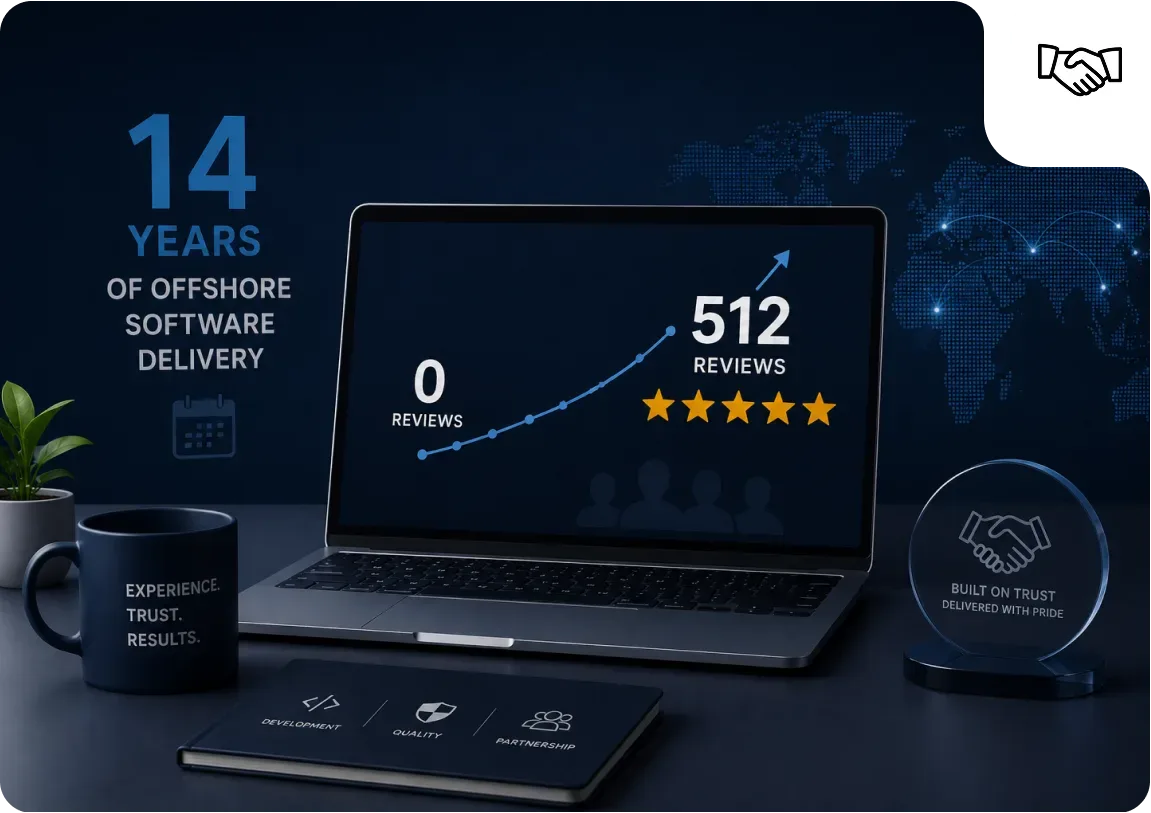
From 0 to 512 Reviews: What 14 Years of Offshore Software Delivery Actually Looks Like
In 2012 Francisco Escobar took a chance on a team he had never met. He is still a client in 2026. This is what 14 years of offshore software delivery actually looks like, written by Akash Singh, CTO.
In 2012, Francisco Escobar took a chance on a team he had never met in person.
He had found us on Freelancer.com Our Freelancer profile. There were no portfolio case studies to evaluate. There was no track record of reviews to reassure him. There was a conversation: honest about what we could build, honest about what we could not, and honest about how long it would take. He placed the first project. It went well. He placed another.
Fourteen years later, Francisco is still a client. His exact words: "Akash has my full trust." That is not a testimonial I commissioned. It is the conclusion a person reaches after 14 years of technical decisions that served his business rather than the invoice.
I am writing this not to market CV Infotech. I am writing it because the question I get most often is: how do we know we can trust you? The answer is in the record. This is the record.
The Thing Nobody Tells You About Offshore Development
The reputation of offshore software development is shaped by its failures, not its successes. The failed delivery, the disappeared developer, the project that cost twice the quote and shipped half the scope. These are the stories that circulate and become the received wisdom that shapes every new client's anxiety going into the first conversation.
What circulates less is the other story: the agency that delivered correctly in year one, was trusted with something more complex in year two, and is still the first call fourteen years later when something important needs to be built.
The second story exists. I know it exists because it is ours.
What 512 Reviews Actually Represents
The 512 verified 5.0 reviews on Freelancer.com did not accumulate through a review solicitation campaign. They accumulated through the completion of 512 projects, or project phases, where the client felt the outcome was worth recording.
Each review is from a real person with a profile, a history, and a name attached to it. None of them can be edited or removed by us. The 5.0 rating is not curated. It is the average of 512 independent evaluations by clients who had no obligation to leave a review at all.
A review count matters as a data point only if you understand what produced it. A 5.0 rating with 8 reviews tells you very little. The confidence interval is too wide. A 5.0 rating with 512 reviews across 14 years, from clients in the US, UK, Australia, and continental Europe, tells you something specific: the delivery pattern is consistent across project types, client profiles, and time.
I am not telling you this to impress you. I am telling you this because when you take that first chance on a team you have never met, the data you use to make the decision should be independently verifiable. Ours is.
The Principle That Has Survived 14 Years Unchanged
Every discovery call I take starts the same way: what does your business need this to do?
Not: what is your budget? Not: which services are you interested in? What does your business need this to do?
The answer to that question determines the recommendation. Sometimes the recommendation is a full custom build. Sometimes it is a premium WordPress theme with some customisation. Sometimes it is a Shopify plan. And sometimes (and this is the part that surprises people) I tell the person on the call that they probably do not need to hire us at all, because what they need already exists and can be subscribed to for $50 a month.
That honesty is not a growth strategy. It is a principle. The clients who stay for 14 years stay because they learned in year one that the recommendation on the call reflects their situation, not the size of our next invoice. Once a client knows that about you, every future conversation starts from a different foundation.
Steven: Seven Years, Three Platforms, One Team
Steven came to us in 2019 for an AI platform called UltimaBot. He had options. He chose CV Infotech.
Seven years later, UltimaBot is in production, maintained and extended by the same team. We also built UltimaWriter, his AI writing platform, and we have maintained Vakmangids, a platform he had been running before he found us, continuously since 2019.
His words: "I get more quality from CV Infotech than working together with local companies."
He did not say that after one project. He said it after seven years of parallel comparison. He has worked with local development teams. He has worked with us. He has a basis for comparison that most testimonials do not. That comparison, sustained over seven years, is still resolving in our favour.
What Growing With a Client Actually Looks Like
Francisco's WooCommerce build in 2012 looked nothing like the infrastructure we manage for him today. The requirements have changed. The integrations have changed. The complexity has changed. The team working on it has developed alongside those changes.
That is what a 14-year client relationship looks like in practice. Not the same project repeated. A continuous technical commitment that evolves as the business evolves. When the stack needed to change, it changed. When the team needed a new capability, it acquired it. The relationship is not a contract. It is a shared investment in a business outcome.
Laura Maher from Australia described the communication dimension directly: "Communication is 10 out of 10. We barely notice the time difference." She is not talking about response speed. She is talking about the quality of the working relationship across a timezone gap that could easily produce friction if the communication standard were not what it is.
John Gowland commissioned an 8-month real estate platform build. A project of that duration and complexity has hundreds of decision points where a lack of trust produces paralysis. His conclusion after launch: "The service delivered exceeded my expectations." Eight months of decisions, correctly communicated and correctly executed.
Working on a your next project project?
Written scope before billing. $30/hr. We tell you if we're not the right fit.
Akash Singh
View full profileCTO and Co-Founder, CV Infotech · Gurugram, India
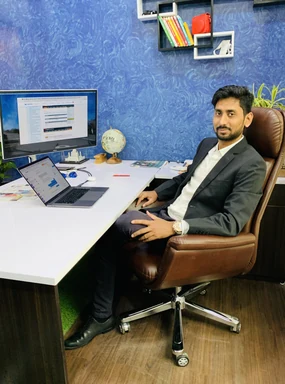
Akash has been building Websites, Web Apps, SaaS and Mobile Apps for clients in the USA, Europe, Australia, and Canada since 2012. He leads a 100% in-house team and personally manages every client relationship and technical decision. Francisco Escobar has worked with him since 2012. Steven has trusted the team with his AI platforms since 2019. 512 verified 5.0 reviews on Freelancer.com.
What I Am Inviting You To
The discovery call at CV Infotech is 30 minutes. It is diagnostic, not a sales presentation. I will ask what your business needs the software to do. I will tell you honestly what I think the right approach is. I will tell you if I think you need us or not.
If the answer is that we are the right fit, I will produce a written scope before any billing begins. Every deliverable listed. Every exclusion named. The rate is $30 per hour. The team is 100% in-house. The same developers stay on your project from kick-off to handover. No subcontracting.
We are at 512 reviews in terms of the number. What they represent is the willingness of 512 clients to put their name behind the experience of working with us on a platform where neither the rating nor the content can be modified by us after submission. That is the only metric I care about. If you want to understand what working with CV Infotech looks like before committing to anything, start with letsbuild@cvinfotech.com. The first conversation is free and honest.
Frequently Asked Questions
Related
512 Reviews · 5.0 Rating · 14 Years · $30/hr
The First Conversation Is
30 Minutes and Free
Diagnostic, not a sales call. We tell you what the right approach is for your business, including when that approach is not us. Written scope before any billing begins.